
Cannabis concentrates are products in which the plant’s resin has been separated from the leaf and stem, leaving a far stronger material than dried flower. Shatter, wax, rosin, live resin, hash and distillate are all concentrates, and they differ in how they are made, how they look and how they feel. If you want to buy well, you need to know three things: the family a product belongs to, the potency printed on its label, and how small a first dose should be. This guide covers all three. At Budmail we curate concentrates from small-batch growers, so we have organized the guide the way we would walk a friend through our concentrates category.
A note on scope: this guide is about the products, not the law. For legal questions, please read the disclaimer on our site.
TL;DR
- A concentrate is cannabis resin separated from the plant. It is made either with a solvent (shatter, wax, live resin, distillate) or without one (hash, rosin, bubble hash, dry sift).
- Concentrates are much stronger than flower. Health Canada lists dried cannabis at up to 30% THC and chemically concentrated extracts at up to 90%.
- Texture (glassy, crumbly, saucy, buttery) mostly tells you how a product was made and handled, not how strong it is.
- Read the front label for Total THC and Total CBD, then the ingredient list. A batch-specific lab report tells you more than the product name.
- Start with a very small amount, wait, and keep everything stored away from children and pets.
Table of Contents
- What a concentrate is, and how it differs from flower
- The two big families: solvent-based and solventless
- The main types, one by one
- Potency: what the number does and does not tell you
- How to read a concentrate label
- Using concentrates with care
- If you prefer not to inhale
- Choosing your first concentrate
- Where to find them
- Our perspective
- FAQ
- Sources
What a concentrate is, and how it differs from flower
Flower is the dried bud. Its THC is spread through plant material you do not use. A concentrate strips most of that material away and keeps the resin, the sticky part that carries cannabinoids and terpenes (the aromatic compounds that give a strain its smell).
The numbers show the gap. Health Canada’s overview places physically concentrated products such as hash and kief at up to 60% THC, chemically concentrated extracts such as shatter, budder and wax at up to 90%, and dried cannabis at up to 30%. A Washington State regulator reported that in 2022 the average was 21% THC for flower and 69% for concentrates. The FNHA puts Canadian concentrates at 40% to over 90% THC, against around 20% for dried cannabis.
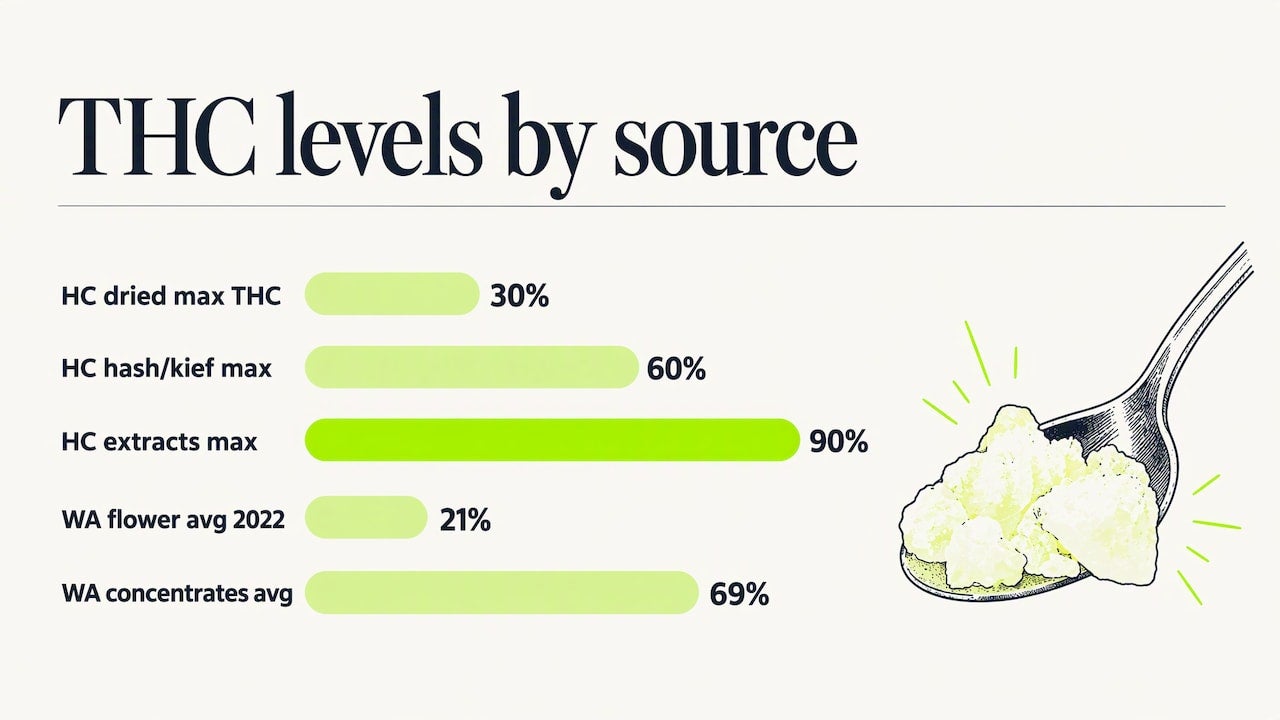
That is the whole reason people choose them: a small amount goes a long way, flavour can be intense, and the effects arrive fast when inhaled. It is also the reason the dose matters so much, which we get to below.
You will see “concentrate” and “extract” used interchangeably. In industry usage, a concentrate is any product where resin has been concentrated, while an extract is generally a concentrate made with a solvent. So all extracts are concentrates, but rosin and dry sift are concentrates rather than extracts.
The two big families: solvent-based and solventless
The fastest way to sort the shelf is by method. Québec’s public health guidance describes it simply: extracts are obtained by chemical extraction with a solvent such as butane or propane, or by physical extraction using pressure or heat.
| Method | What it produces | Typical feel |
|---|---|---|
| Hydrocarbon (butane or propane) | Shatter, wax, live resin, diamonds | Glassy to soft, very aromatic |
| Ethanol | Crude oil, RSO, distillate | Thick oil, little aroma unless terpenes are added |
| CO2 | CO2 oil, distillate | Smooth oil, often used in cartridges |
| Heat and pressure | Flower rosin, hash rosin, live rosin | Sappy to buttery |
| Ice water | Bubble hash | Crumbly, sandy |
| Dry sifting | Dry sift, pressed hash | Powdery to pliable |
The mapping above follows Terpenes and Testing’s extraction guide. For a deeper side-by-side, see our piece on solventless vs solvent-based extraction.
Two more terms come up on product pages. “Live” means the plant was frozen fresh after harvest rather than dried first, a choice made to hold onto more terpenes. “Cured” or “dry” products start from dried, cured plant material. Live products tend to smell brighter, and cured ones can be smoother and often more affordable.
The main types, one by one
Shatter, wax, budder and crumble
These are all hydrocarbon extracts, and the difference is largely texture. NIDA notes that butane-extracted products may be a gooey liquid, a soft solid like lip balm, or a hard amber solid. Shatter is the hard, glassy, translucent one that snaps. Wax, budder and crumble are opaque and softer, from creamy to dry and crumbly. We compare them in detail in shatter vs wax vs crumble and in a shorter shatter vs wax explainer.
Live resin, sauce and diamonds
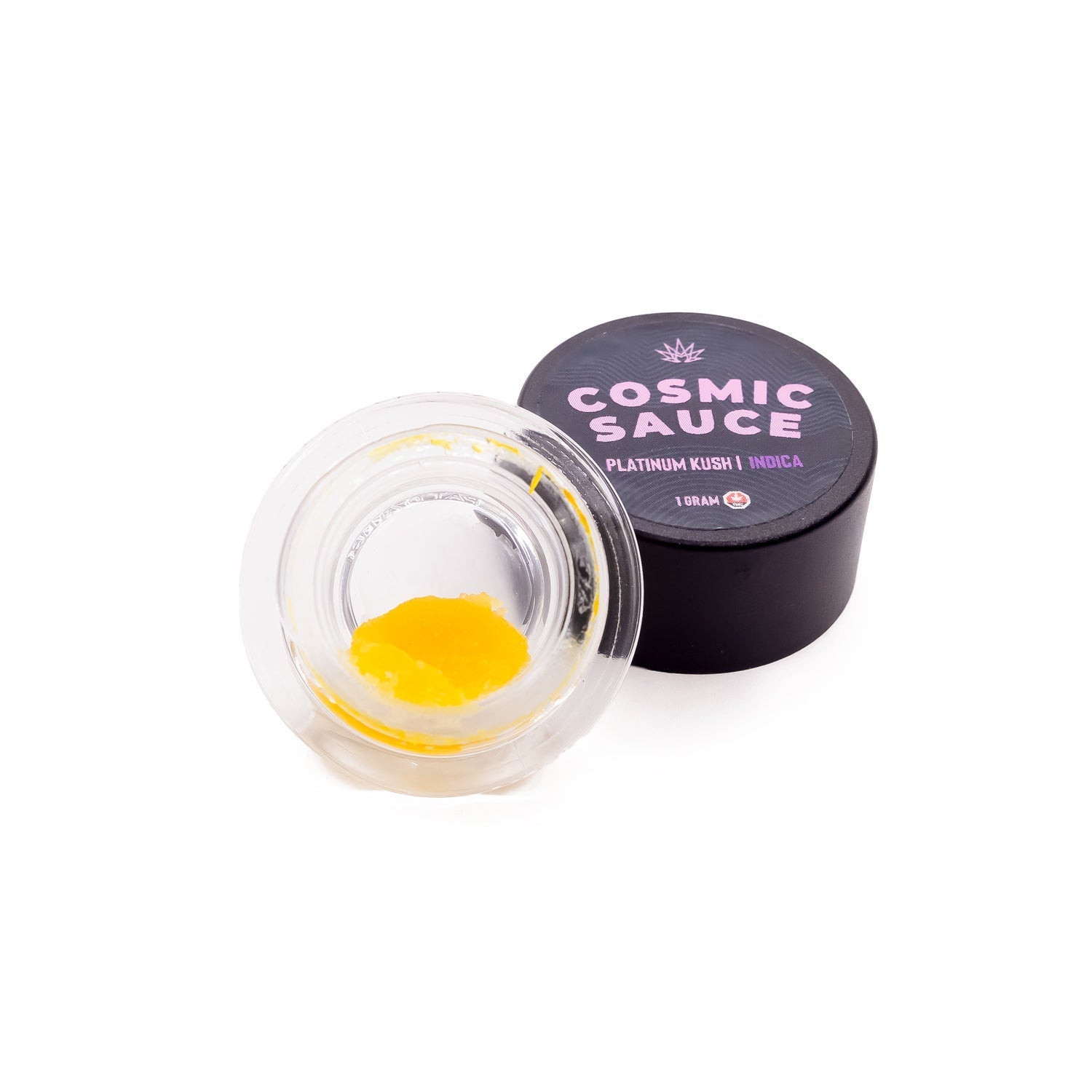
Live resin is made from fresh-frozen plant and is prized for flavour. Sauce is a loose, terpene-rich liquid with crystals suspended in it, and diamonds are the crystalline THCA itself, often sold alongside sauce. If you want the flavour-first end of the shelf, this is it. Our listings include Cosmic Concentrates Sauce (1g) and Hive Diamonds (28g).
Rosin
Rosin is pressed with heat and pressure, with no solvent. Flower rosin comes from bud, hash rosin from hash and live rosin from fresh-frozen material. It is the choice of people who want a product made by a physical process alone.
Hash, kief and bubble hash
These are the oldest concentrates. Kief is the loose resin glands sifted off flower, hash is that resin pressed or rubbed together, and bubble hash is resin separated with ice water. They are physical concentrates, which is why Health Canada groups them in a lower potency band than chemical extracts. Our hashish category carries this family.
Distillate and oils
Distillate is a refined oil, typically very high in THC and mild in flavour, which makes it a common base for vape cartridges. Oils, tinctures and capsules are made for swallowing or placing under the tongue rather than inhaling. Read more in our guide to cannabis distillate. For a walk-through of how six popular types are used, see 6 popular cannabis concentrates and how to use them.
Potency: what the number does and does not tell you
Solvent-based concentrates in a NIDA fact sheet averaged about 54 to 69% THC, versus 39 to 60% for non-solvent methods. Those are averages, though. Potency is not set by the extraction method alone, and one batch of hash can outrun another batch of shatter.
So do not shop by texture or by name. Shop by the printed Total THC and by the batch. A certificate of analysis (a lab report for that specific batch) is more informative than the product name. If you want to understand what such a report checks, our guide to lab testing and how to read the results walks through it.
Remember also that percent THC is not the same as dose. One gram at 80% THC holds 800 mg of THC. A dab the size of a grain of rice is a lot more than it looks.
How to read a concentrate label
Health Canada’s labelling guidance gives you the checklist. A cannabis extract label shows Total THC and Total CBD on the front, the standardized cannabis symbol, a yellow-box health warning, the product class and intended use, and a full ingredient list in descending order of weight, with food allergens listed for extracts.
In practice, look for:
- Total THC. This is the figure that sets your dose. Compare it per gram, then think in milligrams.
- The ingredient list. A pure resin product should read short. A cartridge may list a diluent or added terpenes.
- Product class and intended use. Inhaled, ingested and topical products are not interchangeable.
- Batch information. Match the batch number to the lab report when one is provided.
This is where curation helps. We source small-batch, low-yield strains from growers we consider trustworthy, and quality assurance is the reason we built our catalogue that way.
Using concentrates with care
Because concentrates are strong, health agencies are direct about the risks. Health Canada notes that higher-THC products raise the risk of psychotic symptoms such as severe paranoia and anxiety, and over time of dependence. NIDA explains that dabbers inhale the entire dose in a single breath, delivering a large amount of THC quickly. The FNHA also lists residual solvents and lung irritation, such as chronic cough, among the inhalation concerns.
The practical rules that follow:
- If you vape, use a regulated product, do not modify it, and begin with one or two puffs of a product at 10% THC (100 mg/g) or less. Avoid deep inhalation, breath-holding and alcohol, per the Council of Chief Medical Officers of Health.
- If you swallow an oil, edible or capsule, start with 2.5 mg THC or less. Effects can take up to 2 hours to show and up to 4 hours to reach full strength, so wait before taking more (same source).
- Store it securely. Keep products in their original child-resistant packaging or clearly labelled containers, away from food and out of reach of children and pets. Health Canada reports that most accidental poisonings involve children under 12, most of them under 5.
- Do not use during pregnancy or breastfeeding, and do not drive impaired (same Health Canada page).
If you have a mental health condition, take medication, or are unsure how cannabis fits with your health, talk to your doctor or pharmacist before you start. For a closer look at technique, our article on vaping and dabbing trends, tips and safety and the primer what is dabbing cover the equipment and the habits.
If you prefer not to inhale
Many of our customers choose edibles for the predictability of a measured dose, and public health guidance points the same way for people who want to avoid inhaling: the CCMOH statement offers oils, tinctures and topicals as non-inhalation options. Our catalogue includes edibles and beverages, tinctures and capsules, CBD and topicals, so the same curation applies whether you want a lung-free option or a flavour-led dab.
One point about oils: a concentrate-based oil is not an edible in the everyday sense. It is dosed by the drop or the capsule, so measure it, and use the 2.5 mg starting point above.
Choosing your first concentrate
Match the product to what you want:
- Flavour first: live resin, sauce or live rosin.
- A traditional, plant-forward product: hash, kief or bubble hash.
- Easy to measure and discreet: a regulated vape or a capsule.
- No inhaling: tincture, capsule, edible or topical.
- Something rare: limited small-batch drops, which sell out because the yields are low.
For each, begin at the bottom of the dose range, keep a note of the product and batch you tried, and change only one thing at a time. That note is also how you find a favourite worth reordering.
Where to find them
Budmail is an online marketplace built around finely curated cannabis, with concentrates, hashish, edibles, vapes, CBD and more. We focus on small-batch, low-yield strains and exotic, hard-to-find products from growers we trust. You can mix and match in bulk deals, orders over $200 ship free, and our loyalty rewards program pays back repeat orders.
Start with the concentrates category, or go straight to a listing such as Trichome Gardens CO2 Oil. The full range is on our home page.
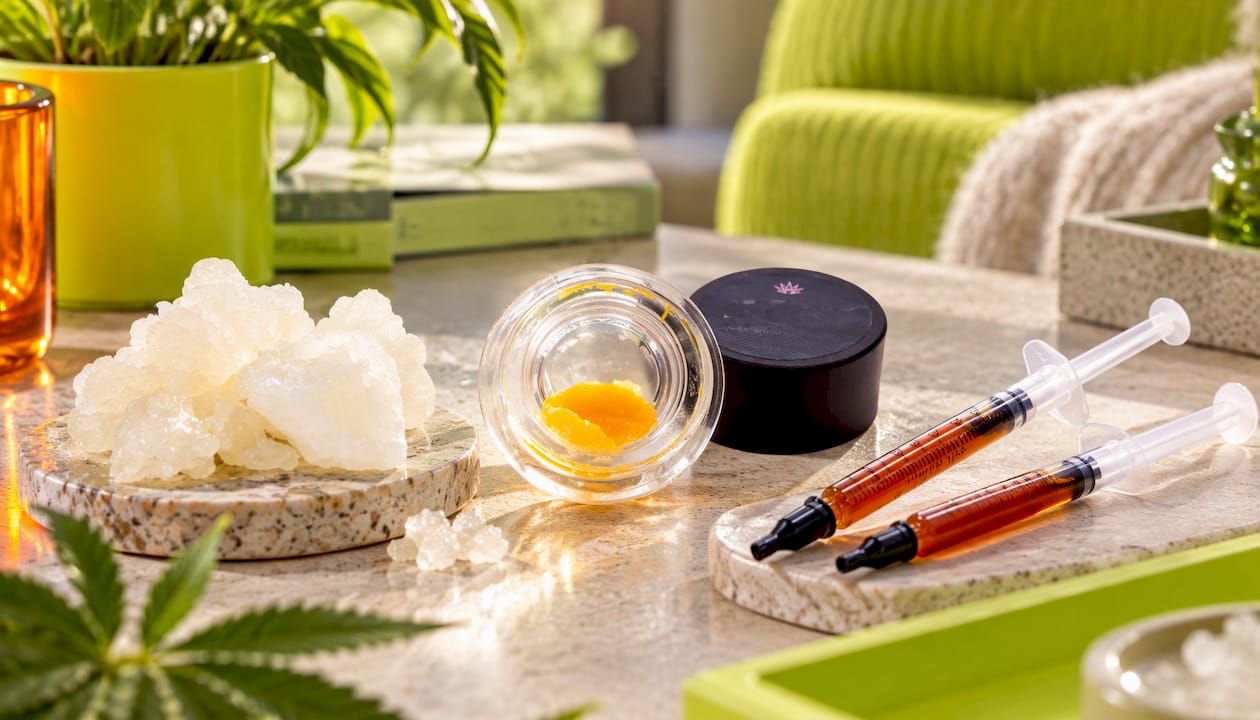
If you are still comparing styles, our longer explainer on the types of cannabis concentrates shows each one with its typical use.
Our perspective
Concentrates reward people who pay attention. The difference between a forgettable product and a memorable one is rarely the headline THC number. It is the grower, the batch size, how fresh the plant was when it was processed and how carefully the product was handled afterward.
That is why we curate the way we do. We look for small-batch, low-yield strains from growers we trust, because those are the strains that give a concentrate its character, and we make the exotic and hard-to-find ones available in one place. Our range spans flower, concentrates, hashish, edibles, vapes, CBD, tinctures, capsules and topicals, so someone who starts with a dab and later wants something gentler for evenings can stay with one source.
We also think value should be easy to see: mix-and-match bulk deals, free shipping on orders over $200 and loyalty rewards for customers who come back. Our advice to anyone new is the same as our own habit: read the label, start small, wait, and keep notes on what you liked.
the author
FAQ
What is the difference between shatter and wax?
Both are usually hydrocarbon extracts. Shatter is hard, translucent and glassy, while wax is opaque and soft, from creamy budder to dry crumble. The texture reflects how the extract was handled after extraction, so judge potency by the label, not the look.
Are concentrates stronger than flower?
Yes. Health Canada lists dried cannabis at up to 30% THC and chemically concentrated extracts at up to 90%. Because of that gap, begin with a very small amount and wait before taking more.
What is the difference between a concentrate and an extract?
In industry usage, a concentrate is any product where resin has been concentrated, and an extract is one made with a solvent. Rosin and dry sift are therefore concentrates but not extracts, as Terpenes and Testing explains. On a shelf, the two words are often used loosely.
What should I look for on the label?
Check Total THC and Total CBD on the front, the product class and intended use, and the ingredient list. Health Canada’s label guide explains each element.
How much should a beginner take?
For swallowed products, 2.5 mg THC or less, then wait up to 2 hours before more. For vaping, one or two puffs of a product with 10% THC or less. Both figures come from the CCMOH statement.
Sources
- About cannabis, Health Canada
- Understanding THC Concentration and Potency, Washington State Liquor and Cannabis Board
- What You Need to Know About Cannabis Concentrates, FNHA
- Cannabis Extraction Methods: The Complete Guide, Terpenes and Testing
- Forms and methods of cannabis use, Gouvernement du Québec
- Marijuana concentrates fact sheet, NIDA
- How to read and understand a cannabis product label, Health Canada
- Understanding cannabis health effects: how to reduce your risk, Health Canada
- CCMOH statement on cannabis extracts, edibles and topical products
Recommended
- Dosing Cannabis Concentrates Responsibly
- 6 Popular Cannabis Concentrates and How to Use Them
- Cannabis Concentrates 101: What Is Dabbing?
- Shatter vs Wax vs Crumble Cannabis
This information is for educational purposes only and is not intended as medical advice or a prescription. Always consult a qualified healthcare professional before using cannabis, particularly if you have existing health conditions or concerns. Cannabis is regulated in Canada under the Cannabis Act. Consume responsibly and be mindful of your health and well-being.


