
A cannabis gummy works differently from a joint or a vape. You usually feel it 30 minutes to 2 hours after eating it, and it can last many hours. That is why the best gummy experience starts with a small, accurately dosed piece from a source you trust. At Budmail we curate THC and CBD gummies with clear milligram labels, so you can plan your dose before you take it.
TL;DR
- Health Canada says effects from eating cannabis start within 30 minutes to 2 hours and may be strongest after 2 to 4 hours.
- Effects commonly last 4 to 8 hours, and some residual effects, such as drowsiness, can last up to 24 hours.
- New consumers should choose 2.5 mg THC or less and wait to feel the full effect before taking more.
- Too much can cause severe anxiety, paranoia, nausea or a racing heart. Know the warning signs and who to call.
- Do not drive after a gummy, and keep gummies locked away from children and pets.
Table of Contents
- What a cannabis gummy does to you
- When the effects start and when they peak
- How long a gummy high lasts
- How much to take
- When a gummy is too much
- Safe use: driving, age, medications and children
- Perspective
- Where to start with Budmail
- FAQ
- Sources
What a cannabis gummy does to you
When you eat a gummy, the THC travels through your digestive system before it reaches your bloodstream. In the US, palliative care physician Dr. Diana Martins-Welch explains that the liver converts ingested THC into 11-hydroxy-THC, a more potent compound that lingers longer. That is why a small gummy can feel stronger and last longer than a few puffs of a joint.
What people usually notice with a well-chosen dose:
- Relaxation and a calmer mood
- Sounds, flavors and thoughts that feel richer or wander more freely
- Dry mouth and an increased appetite
- Sleepiness, especially later in the effect
- Dizziness or altered perception, which vary by person
The same physician says that most people want to feel relaxed, not altered. A low dose is how you get there.
THC gummies and CBD gummies
THC is the compound that causes the high. CBD does not intoxicate in the same way, so a CBD gummy is a different experience: no high, and often chosen by people who want the gummy format without intoxication. Many products combine both, so read the label for the milligrams of each. Budmail carries both THC and CBD options in its gummy range, and our edibles guide explains how the formats compare.
When the effects start and when they peak
Health Canada states that effects from eating or drinking cannabis start within 30 minutes to 2 hours, may be strongest after 2 to 4 hours, and can last 4 to 8 hours. Timing depends on the product format, other oral medications, and the amount or type of food in your stomach.
The British Columbia government adds that how soon and how long effects last depends on weight, metabolism, sex and whether you eat on an empty stomach. Two people can eat the same gummy and have very different evenings.
That gap between eating and feeling is the main reason edibles catch people out. Health Canada’s warning messages, updated on March 12, 2025, state that it can take up to 4 hours to feel effects, and that eating more before you feel anything can cause cannabis poisoning, including severe anxiety and panic attacks.
How long a gummy high lasts
Health Canada gives a typical window of 4 to 8 hours. British Columbia’s fact sheet says the intoxicating effects of edibles can last up to 12 hours, with some residual effects up to 24 hours. The Windsor-Essex County Health Unit likewise notes that effects can last 12 to 24 hours.
| Stage | Typical timing for a gummy |
|---|---|
| First effects | 30 minutes to 2 hours |
| Strongest effects | 2 to 4 hours |
| Main effects | 4 to 8 hours |
| Upper range of intoxication | Up to 12 hours |
| Residual effects such as drowsiness | Up to 24 hours |
If you want a closer look at timing, our page on how long edibles last goes deeper. Plan your day around the long end: take a gummy in the evening, at home, with someone you trust. That is Health Canada’s own advice for safe use.
How much to take
In Canada, an immediate container of edible cannabis may contain no more than 10 mg of THC. Health Canada describes this as a precautionary ceiling, not a safe dose or standard serving. The federal amendments that took effect on March 12, 2025 kept that 10 mg limit per immediate container.
For you, the practical guidance is:
- Start with 2.5 mg THC or less. Health Canada advises this for new consumers. For medical users, it suggests considering 1.25 mg if you are over 55, have certain health conditions, or take medications that may interact with THC and CBD.
- Wait. British Columbia advises at least two hours before a second 2.5 mg dose. The Windsor-Essex County Health Unit says to wait at least 4 hours before having more. Waiting the longer time is the safer choice.
- Do not stack doses. CMAJ editors describe how people used to the instant effect of inhaling take too much before the first dose peaks, a common route to unintentional overdose.
Worked example: a gummy labeled 10 mg is four 2.5 mg portions. Cut it with a clean knife, or choose a product with a lower milligram count per piece. Eat one portion at 7 p.m., then do nothing more until at least 9 p.m., and ideally closer to 11 p.m. before you think about another. Our guides to THC edible dosage and the dosage chart for beginners lay out the milligrams in more detail.
Health Canada also notes that there is no known maximum recommended THC dose for any health condition, so more is not a safer or better target.
When a gummy is too much
The Windsor-Essex County Health Unit lists these signs of overconsumption: sleepiness, dizziness or confusion, nausea and vomiting, a racing or very slow heartbeat, fainting, chest pain, severe anxiety or panic, and paranoia or delusions. British Columbia’s fact sheet adds extreme sedation and hallucinations.
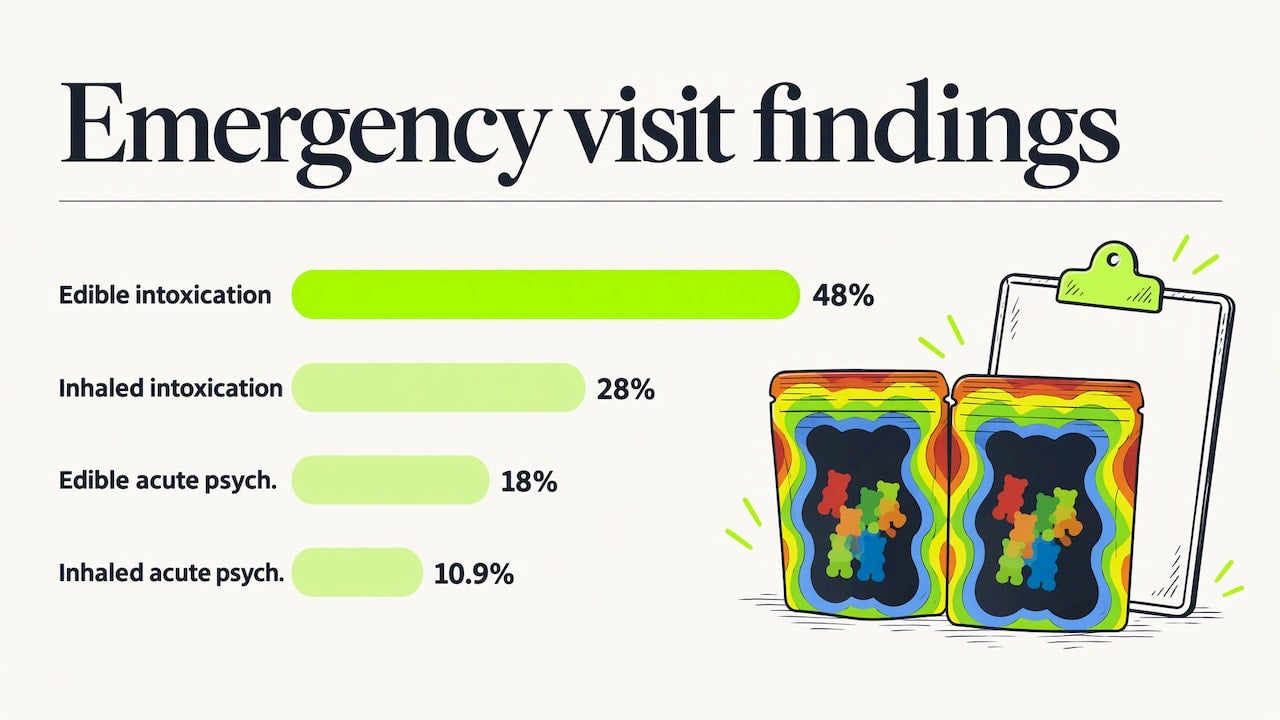
A study of 9,973 cannabis-related emergency visits, summarized in CMAJ, found that edible users were more likely than inhaled-cannabis users to arrive with intoxication (48% vs 28%) and acute psychiatric symptoms (18% vs 10.9%). JAMA Internal Medicine editors say the delayed action of edibles makes it easy to take too many doses, and the effect can include distress lasting hours.
If you feel unwell:
- Call 911 for chest pain, fainting, breathing trouble or severe symptoms.
- In Ontario, call the Ontario Poison Centre at 1-800-268-9017. In British Columbia, call BC Poison Control at 1 800-567-8911 or 604-682-5050.
- Stay in a safe, calm place with someone you trust until it passes.
For comfort measures while you wait it out, see our page on recovering from edibles.
Safe use: driving, age, medications and children
- Driving: British Columbia says to keep at least eight hours free where you will not need to drive, operate machinery or look after others. Active Aging Canada states that driving after cannabis is illegal in Canada, that there is no evidence for a safe level for driving, and that drowsiness can last up to 24 hours.
- Age: Health Canada’s 2025 warning messages say that using cannabis before age 25 can harm brain development and raise the risk of mental disorders, and that higher THC raises the risk of paranoia, anxiety and dependence. Daily or near-daily use can lead to dependence.
- Medications and health: Dr. Martins-Welch notes that THC can interact with blood thinners and sedatives, and that people with psychiatric conditions or a family history of psychosis should avoid THC. Speak to your doctor or pharmacist if either applies to you.
- Older adults: Those new to cannabis later in life face a higher risk of overconsumption, because they have no experience with the product.
- Children and pets: Health Canada warns that edibles can poison children, with severe cases involving hospitalization for breathing difficulties, seizures or coma, especially under age 5. Keep gummies out of reach. A Children’s Hospital of Eastern Ontario review found that 76% of unintentional exposures were to edibles, including gummies, and 32% of the children needed admission.
Perspective
Gummies reward patience and accurate labeling. The effect you get depends on knowing exactly how many milligrams are in each piece, and the delay means you only get one chance per evening to set your dose correctly.
That is why we focus on curated, quality-assured products from small-batch growers we trust, and on clear labeling. When the number on the package is the number you can plan around, a low and slow approach actually works. Our mix-and-match bulk deals and loyalty rewards let you keep a steady supply of the products you already know, rather than gambling on something new every time.
Start low, wait, and note what you felt. A good gummy should leave you relaxed, not regretful.
the author
Where to start with Budmail
If you want to try a gummy at a measured dose, browse our gummies and read the milligrams per piece before you choose. Popular picks include Gummies (Kandy Kandy) 900mg, Bliss Gummies 1080mg and Ganja Edibles Gummy Bears 150mg. Orders over $200 ship free, and our loyalty rewards program adds value on repeat purchases.

For the full range, from flower to concentrates and CBD, visit Budmail.
FAQ
How hard do edibles hit you?
It depends on dose, body and stomach contents. Health Canada says effects may be strongest 2 to 4 hours after eating. Starting at 2.5 mg THC or less keeps the experience manageable.
How long does a gummy high last?
Typically 4 to 8 hours according to Health Canada. British Columbia says intoxicating effects can last up to 12 hours, with residual effects such as drowsiness up to 24 hours.
How many edibles equal a joint?
There is no reliable equivalent. Edible THC is processed by the liver, which Dr. Martins-Welch says makes a small gummy feel stronger than a few puffs. Treat each format separately and start low.
Can I take another gummy if I feel nothing?
Not yet. British Columbia advises at least two hours before a second 2.5 mg dose, and the Windsor-Essex County Health Unit says to wait at least 4 hours. Health Canada warns that eating more before you feel an effect can cause severe anxiety and panic.
Sources
- Health Canada: Using a cannabis product
- Health Canada: Cannabis health warning messages
- Windsor-Essex County Health Unit: Cannabis Edibles
- Health Canada: Final Cannabis Regulations
- Canada Gazette, SOR/2025-43
- CMAJ: Edible cannabis
- JAMA Internal Medicine: Cannabis edibles
- Active Aging Canada: Cannabis and Older Adults
- Unintentional cannabis exposures in children
- Northwell Health: Why edibles are so strong
- Northwell Health: A doctor’s guide to cannabis gummies


