
A rechargeable weed vape is a battery you charge and reuse, paired with a cartridge or pod of cannabis oil that you replace when it runs out. Because the battery is the part you keep, the best purchase is a legal, labelled oil product you trust, plus a battery you charge the way Health Canada advises. If you would rather skip the hardware decision, you can browse our vape selection, which includes ready-to-use disposable pens.
TL;DR
- A rechargeable pen has two parts: a lithium-ion battery you recharge and an oil cartridge you swap out. A disposable has both in one sealed unit.
- Check the label before anything else: Total THC, the yellow health warning box, lot number, packaging date and an excise stamp.
- Charge on a hard, non-flammable surface, use a certified charger, and never modify the device or leave it charging past the recommended time.
- Ontario sales data show vaping products carry the highest average prices among cannabis formats, so the cost of cartridges matters more than the sticker price of the battery.
- Not sure you want to manage a charger? A ready-to-use pen lets you skip the setup.
Table of Contents
- What a rechargeable cannabis vape pen actually is
- How the battery works and what affects its life
- What a rechargeable vape costs in Canada
- Reading the label before you buy
- Charging and battery safety
- Habits that make a pen last and taste better
- Ready-to-use pens from Budmail
- Matching a vape to the way you use cannabis
- FAQ
- Sources
What a rechargeable cannabis vape pen actually is
People use “rechargeable weed vape” and “rechargeable cannabis vape pen” for the same thing: a slim, battery-powered device that heats cannabis oil into vapor instead of burning anything. Most are built from three parts.
- Battery: a rechargeable lithium-ion cell, the same family of battery found in cellphones, according to Leafly’s anatomy of a vape pen.
- Atomizer: the heating element, nested in a steel or ceramic housing, that turns oil into tiny vapor droplets.
- Cartridge or pod: the tank holding the oil, which also carries the mouthpiece.
Health Canada describes inhalation accessories in much the same way: a battery, a mouthpiece, a heating element and a cartridge, and it notes that malfunctions have rarely caused injury.
Rechargeable pen versus rechargeable disposable
The confusion starts here. A classic rechargeable pen is modular: you keep the battery and replace the cartridge. A rechargeable disposable is a single sealed unit with a charging port, usually USB-C, so you can finish the oil on one charge cycle after another, then throw the whole thing out. A basic disposable has no port at all and is simply used until empty.
Which suits you depends on how you vape:
- Occasional use, no fuss: a sealed, ready-to-use pen means no matching of parts, no threads, no charger to lose.
- Regular use, variety: a reusable battery lets you swap between cartridges and strains.
How the battery works and what affects its life
When you press the button, or just draw on an auto-draw model, the battery sends current to the atomizer. Leafly notes that vape pens heat cannabis to roughly 315 to 465°F to activate cannabinoids, and that some pens cycle through temperature settings with button clicks.
Three things shape how long one charge and one cartridge last:
- Draw length. Long, slow pulls keep the coil heating longer, using more battery and more oil.
- Power setting. Higher voltage means bigger clouds, faster oil use and quicker battery drain.
- How often you vape. Frequent short sessions can drain a small battery in a day or two. Occasional users may only charge it weekly.
This is why a cartridge’s gram weight is a poor guide to puff count. Two people using the same 1 g cartridge can finish it in very different timeframes.
What a rechargeable vape costs in Canada
The battery itself is usually the cheap part. The recurring cost is oil. A Journal of Cannabis Research study of the Ontario market, covering sales from January to April 2024, found vaping products had the highest average selling prices of the formats studied:
| Product type | Average price | Range |
|---|---|---|
| Disposable vapes | $159.87 | $83.16 to $251.60 |
| 510-thread cartridges | $153.72 | $36.50 to $240 |
| Closed-loop pods | $144.72 | $115.90 to $196.22 |
| Pax pods | $240 | n/a |
The same study put 510 cartridges at an average of $37.70 per gram. These are averages across a whole provincial market and the pack sizes behind them vary, so use them for scale rather than as a shopping price. What they show is that the range inside each category is wide. Comparing the price per gram, and the THC content per gram, tells you far more than the headline price.
A practical way to compare:
- Note the grams of oil in the pack.
- Divide the price by the grams.
- Check the Total THC percentage on the label, since a lower price per gram with weaker oil is not necessarily better value.
- Factor in the battery: if you already own a compatible one, a cartridge alone is the whole cost.
Reading the label before you buy
Buying legal, tested product matters more with vapes than with most formats, because you inhale what is in the tank. Health Canada’s guide to reading a cannabis label says a legal label must show:
- Total THC and Total CBD
- A yellow health warning box on the front
- The product class and storage conditions
- A lot number and packaging date
- The manufacturer’s contact details
- For extracts, the ingredients in descending order by weight
An excise stamp indicates a Health Canada licence holder, although the guide notes exceptions apply. If a cartridge has no stamp, no lot information and no standardized symbol, put it back.
On the health side, Health Canada states that vaping aerosol contains harmful substances and that heavy metals may leach into the extract, though vaping is less harmful to the lungs than smoking. A 2023 review in Drug and Alcohol Review reports that in Canada, where cannabis is federally regulated, no EVALI cases (the lung injury seen in the US outbreak) were linked to cannabis vaporisation products, and that regulated products must pass standardised testing for contaminants, pesticides, microorganisms and diluents. That is the case for sticking to regulated, labelled oil. Our guide to lab testing and how to read the results walks through what those tests mean.
Charging and battery safety
Lithium-ion batteries are safe in everyday use, but Health Canada’s vaping product safety page is clear that they are hazardous if improperly used, stored, carried, charged or disposed of. Here is the routine that follows its advice:
- Use the right charger. Stick with the charger that came with the device, or a manufacturer-recommended replacement from a trusted source.
- Respect charging time. Do not leave the pen charging for longer than recommended, and do not charge it overnight unattended.
- Charge on a hard, non-flammable surface, not a bed, couch or pile of paper.
- Do not modify the device.
- Carry spare batteries in a protective case, away from coins, keys and other metal objects.
- Look for a safety certification. Health Canada points to standards such as ANSI/CAN/UL 8139 when choosing a device.
- Retire a damaged battery. If it swells, overheats or smells odd, stop using it.
Clean the mouthpiece and connection after use, as Health Canada advises, and follow the manufacturer’s instructions.
When the cartridge is empty
The oil runs out long before a good battery does. Do not toss a cartridge in the household trash without thinking: it contains a battery contact and residue. We cover the options in what to do with empty vape cartridges, and you can keep the battery for the next one.
Habits that make a pen last and taste better
Small habits protect both the battery and the oil:
- Start on a low power setting and move up only if you need to.
- Keep the pen upright when you can, so oil stays near the coil rather than flooding the air channel.
- Avoid chain-vaping, which overheats the coil and burns the oil.
- Store it at room temperature, out of hot cars and direct sun, matching the storage conditions on the label.
Our list of nine things to avoid when vaping cannabis goes further, and the cannabis vape guide covers the basics of cartridges, strengths and devices. If you like the simplicity of a pen, reasons to love cannabis oil pens explains the appeal.
If you have a lung or heart condition, are pregnant or breastfeeding, or take regular medication, speak with your doctor or pharmacist before vaping cannabis. Cannabis is for adults of legal age only.
Our view: start with the oil, not the gadget
Most shoppers compare battery specs, but the thing you actually inhale is the oil. That is why we build our vaping range around products from growers we trust, with a focus on small-batch, low-yield strains and exotic, hard-to-find options.
Our approach is simple: a pen is only as good as what is inside it. Pick the strain and the format that fit your evening, then choose the hardware around it. Choosing a ready-to-use pen means one less thing to charge, match and maintain.
We also like mixing and matching. Our bulk deals let you try several products in one order, and free shipping applies to orders over $200, with a loyalty rewards program for repeat orders.
the author
Ready-to-use pens from Budmail
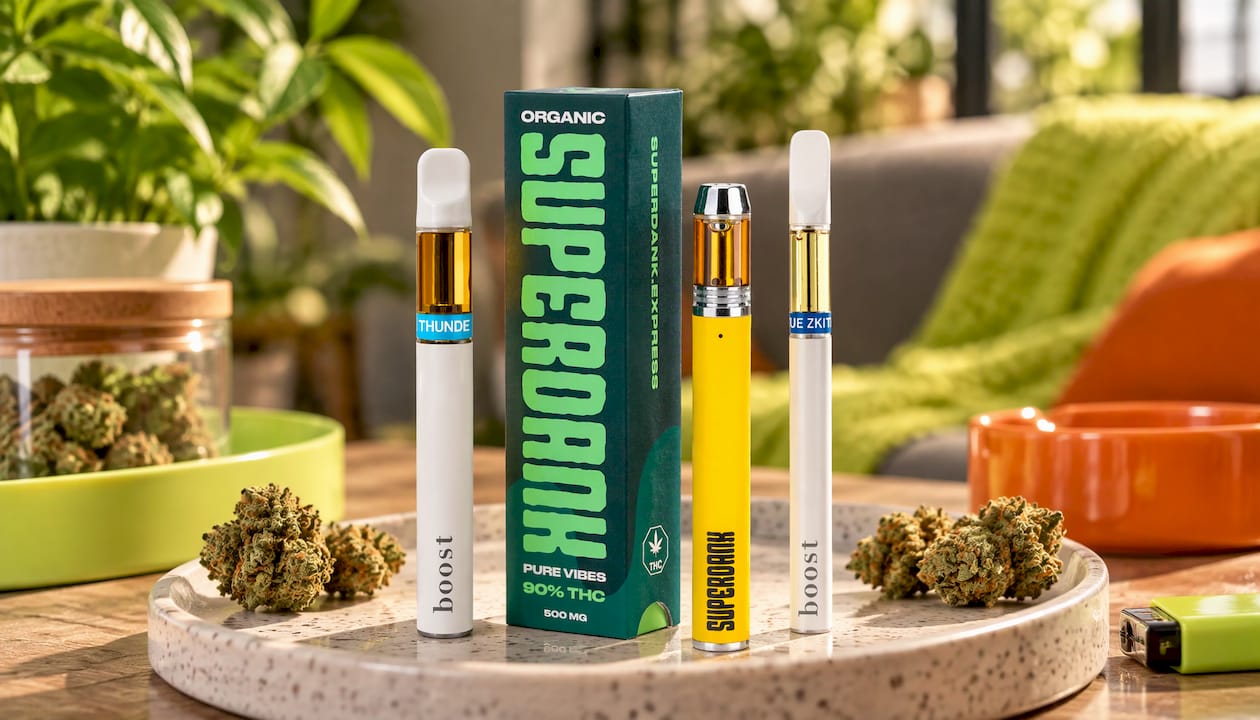
If you want to vape without managing a charger and cartridge thread, our vaping category lists disposable pens such as the Boost disposable vape in 1 g and 2 g sizes, and a SUPERDANK CO2 oil disposable. You can see everything we carry, from flower to edibles and CBD, on the Budmail home page. Orders over $200 ship free.
Matching a vape to the way you use cannabis
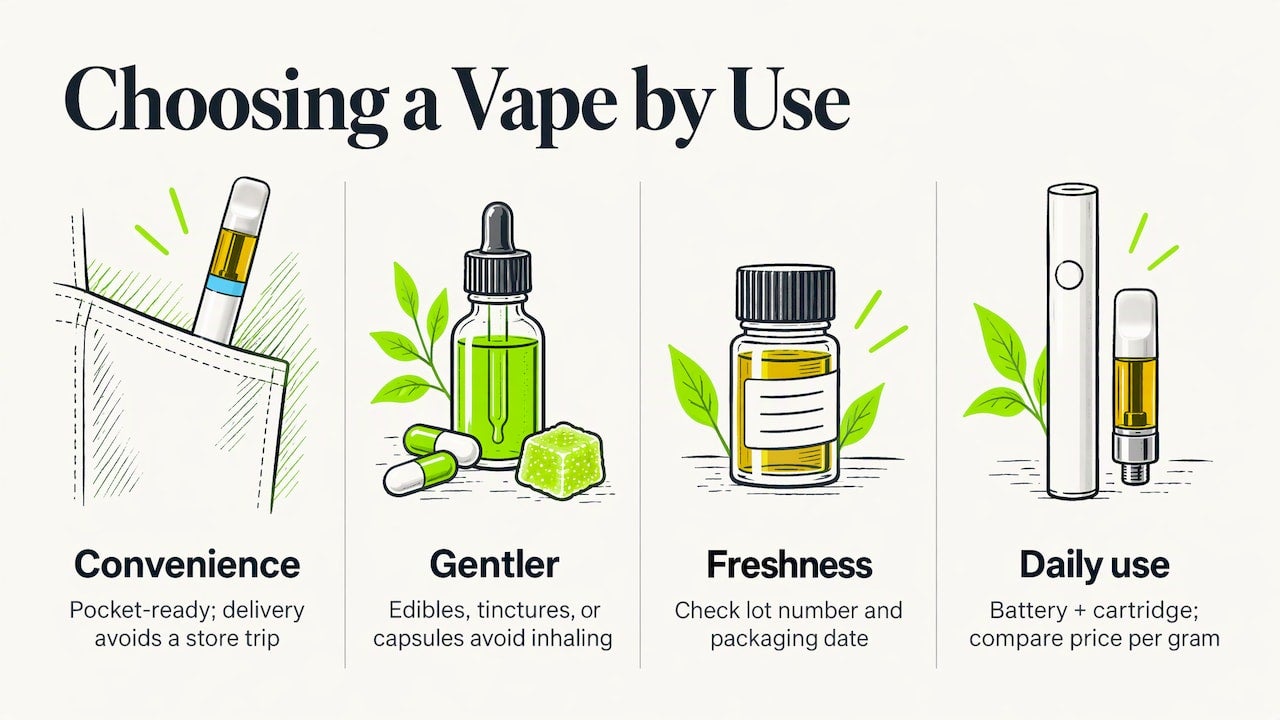
You want convenience. A sealed pen you can slip in a pocket and use right away fits best. Delivery to your door means no trip to a store.
You prefer a gentler option than inhaling. Edibles, tinctures and capsules suit health-conscious buyers who would rather not inhale. Our roundup of the best THC tinctures in Canada is a good place to start.
You collect rare strains. Look for small-batch oil and check the lot number and packaging date on every label, so you know how fresh it is.
You vape every day. A reusable battery with a matching cartridge, charged in a routine spot, will keep running costs predictable. Compare the price per gram rather than the pack price.
FAQ
What is a weed vape battery?
It is the rechargeable lithium-ion power source that heats the coil inside a cannabis oil pen. In a cartridge system it is a reusable part you keep, and it is similar in type to a cellphone battery. Charge it with the recommended charger and replace it if it swells or overheats.
How long does a rechargeable vape pen last?
It depends on battery size, power setting, draw length and how often you vape. Occasional users may charge weekly, while daily users may charge every day or two. A cartridge’s gram weight does not tell you the puff count, so judge by your own use.
How much does a reusable weed pen cost?
The battery is typically the smaller expense, and the oil is the recurring cost. In the Ontario market study, 510 cartridges averaged $37.70 per gram in early 2024, with a wide range between products. Compare price per gram and Total THC on the label.
Can I use any charger?
No. Health Canada advises using the manufacturer’s charger or a manufacturer-recommended one from a trusted source, and not exceeding the recommended charging time. Charge it on a hard, non-flammable surface.
Sources
- Anatomy of a vape pen, Leafly
- An update on cannabis products, cannabinoid content, plant material, Journal of Cannabis Research
- How to read and understand a cannabis product label, Health Canada
- Vaping product safety, Health Canada
- Cannabis accessories for inhalation: minimizing your risk, Health Canada
- Cannabis vaporisation: understanding products, devices and risks, Drug and Alcohol Review


