
Exotic weed is a marketing word, not a legal grade: in Canada it points to small-batch, dense, aromatic, high-THC flower, and the way to tell a real one from a label is to read the chemistry on the package. We curate small-batch, low-yield strains from growers we trust, and this guide shows you how to judge any rare strain, ours or anyone else’s, before you pay a premium for it.
TL;DR
- “Exotic” is slang. Neither the Cannabis Act nor the Cannabis Regulations define it, so the word alone guarantees nothing.
- Rare strains usually come from small batches, careful cultivation and potent, aromatic flower. Judge them by THC, Total THC, terpene percentage, producer and packaged-on date.
- Strain names and indica/sativa labels are weak predictors of effects. Measured chemistry and your dose matter more.
- Rare flower is for experienced users. Start low and go slow, and wait at least four hours before more edibles.
- Our small-batch selection is built for people who want hard-to-find strains, with free shipping on orders over $200 and a loyalty rewards program.
Table of Contents
- What “exotic” actually means
- Why rare strains are rare
- Strains most often called exotic
- How to judge an exotic strain before you buy
- Why the strain name tells you less than you think
- Using rare, high-THC flower safely
- Edibles: the same rare genetics, a different experience
- Our perspective
- Where to find rare strains in Canada
- FAQ
- Sources
What “exotic” actually means
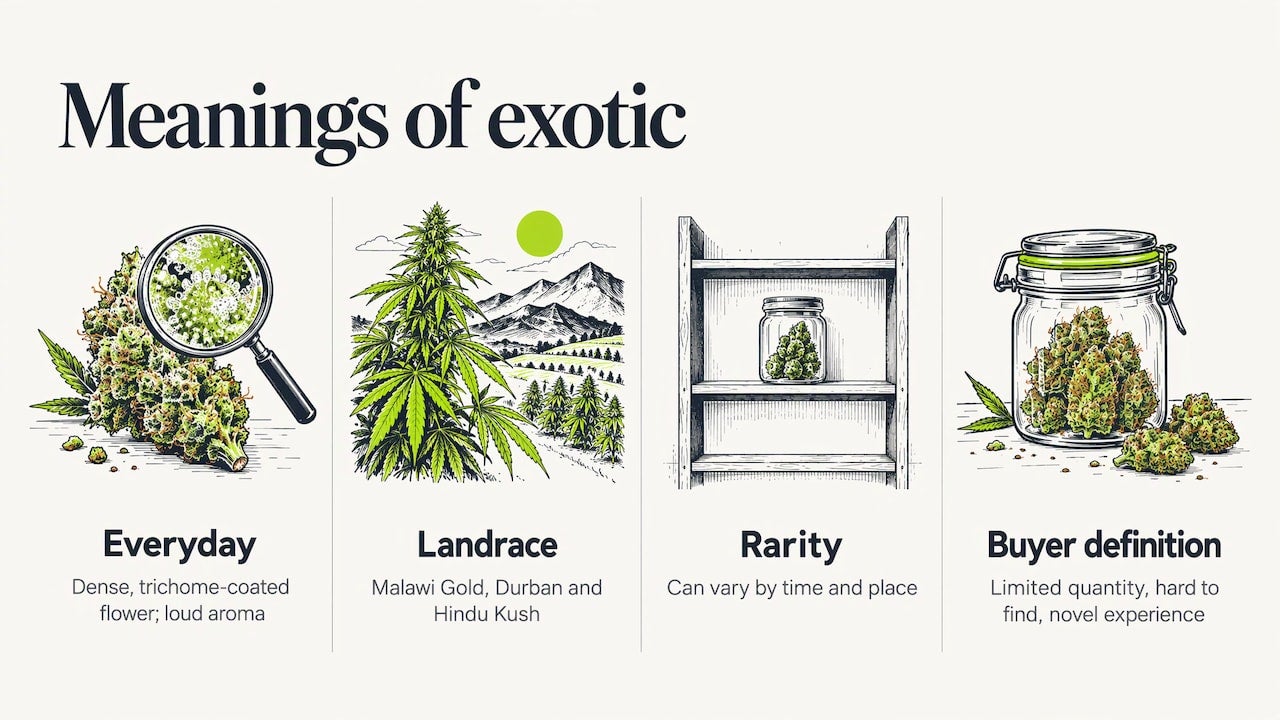
Ask ten budtenders and you get ten answers. In everyday use, exotic describes flower that stands out from standard budget cannabis: dense, heavily coated in trichomes (the tiny resin glands that carry cannabinoids and terpenes), sometimes purple or neon green, with a loud, unusual aroma. That is how WeedDB’s Canadian guide describes it, and it adds that Health Canada does not treat exotic as a product class.
There is also a stricter, older meaning. Some people in the cannabis world use it literally for landrace strains of exotic origin, such as Malawi Gold, Durban or Hindu Kush, which predate most modern strains. For those buyers, verifiable lineage is the quality marker. If that is your angle, our guide to landrace cannabis and the original strains explains where today’s genetics come from.
A third meaning is plain rarity. What counts as rare shifts over time and place, so a strain that is a find in one region can be ordinary in another.
Put together, a useful working definition for a Canadian buyer is this: an exotic strain is hard to find, grown in limited quantity, and delivers a taste, aroma or effect you have not had before. Four traits come up again and again in how the term is used: potency, buzz, novelty and a higher price. THC in the mid-20% range or higher is typical.
Why rare strains are rare
Scarcity is not only hype. It has a growing reason behind it.
A 2023 study by Canadian researchers characterized 176 drug-type cannabis accessions representing Canada’s legal market. Days to maturity from sowing ranged from 70 to 133, and yield per plant from about 6 g to about 177 g. Potential THC correlated positively with maturity-related traits and negatively with yield.
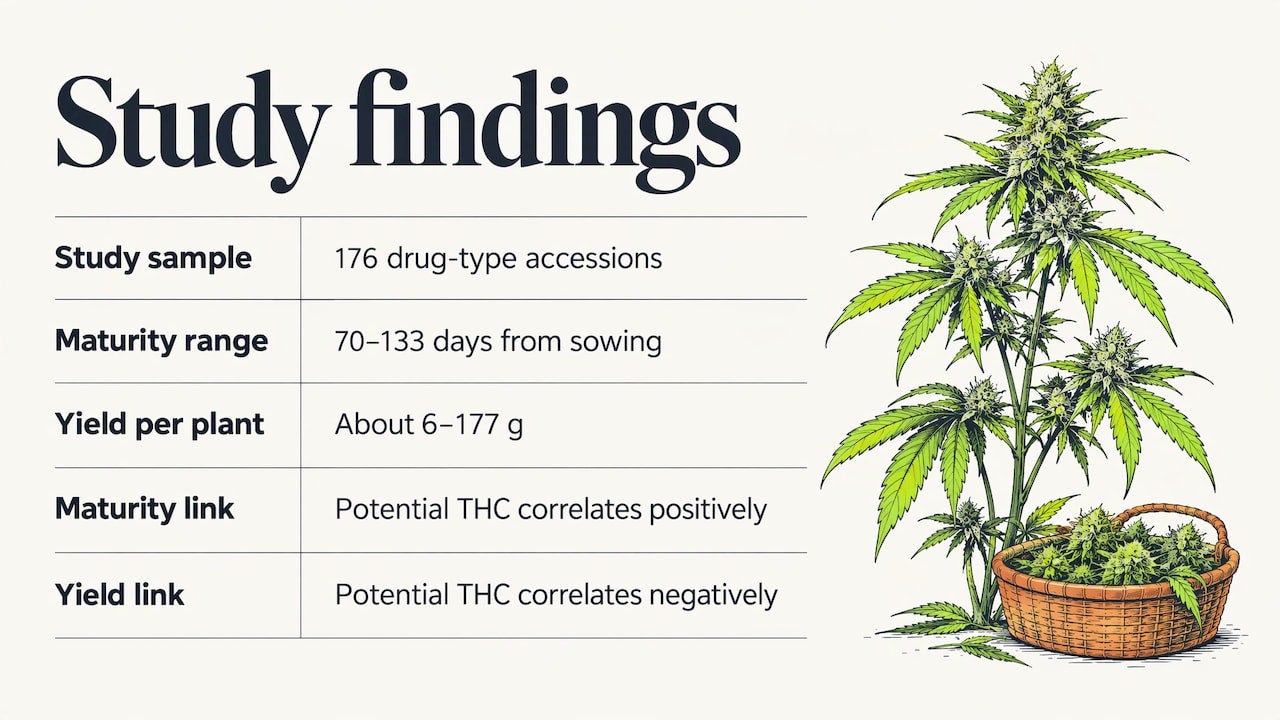
In plain terms: the plants that tend toward the highest potency often take longer and give the grower less flower. A producer chasing volume has little reason to grow them. A grower who accepts low yield for the sake of potency and character produces the small batches that end up labelled exotic. That is the kind of grower we look for, and it is why our focus is small-batch, low-yield strains from reputable growers rather than volume flower.
The same study also found meaningful differences in maturity time and cannabinoid profiles between plants from regular seeds, feminized seeds and cuttings. How a plant is propagated shapes what ends up in the jar.
Strains most often called exotic
Lists of the “best exotic strains” differ from site to site, but a handful show up constantly. Treat the lineages below as reported by growers and strain libraries, not as fixed specifications.
| Strain | Reported lineage | Reported character |
|---|---|---|
| Gelato | Sunset Sherbet crossed with Thin Mint Girl Scout Cookies (Gelato 33 phenotype) | Balanced hybrid, often 24 to 30% THC |
| Biscotti | Gelato #25, Girl Scout Cookies and Florida OG | Indica-dominant hybrid, doughy cookie base |
| Jealousy | Part of the Cookies family | Gas-forward, potent |
| Pinkman Goo | Lineage unknown, suspected Granddaddy Purple, Grape Ape and Northern Lights #5 | Pink flowers with resinous globs, sedating |
| Purple Haze | 70% sativa, 30% indica | Euphoric, energizing, fruity and earthy flavours |
Two details are worth knowing. Pinkman Goo was only established as a stable genetic in 2017, and its exact lineage is still a guess. Purple Haze is considered exotic mostly because it is hard to find despite its fame. So rarity can come from genetics, from newness or from simple availability, and none of those is the same as quality.
Legal Canadian stock turns over quickly. Rare drops sell out, and what is on the shelf this month may not be next month. For what is available now, browse our flower selection rather than relying on any fixed list.
How to judge an exotic strain before you buy
Because the word means nothing on its own, the label’s real information is where you look. Here is a checklist that works for any flower, whatever the marketing says.
1. Read the cultivar, producer and date
A Canadian package carries the cultivar name, the THC and CBD figures, the licensed producer and the packaged-on date. WeedDB recommends checking all of these, then looking at THC and Total THC and the terpene percentage if it is listed. Fresher is better: terpenes fade with age.
2. Understand THC versus Total THC
THC is what is already active in the flower. Total THC accounts for THCA converting to THC when you heat it. For smoking or vaping, Total THC is the figure closest to what you will experience. If you want the basics on the two main cannabinoids, see our explainer on THC versus CBD.
3. Look at terpenes
Terpenes are the aromatic compounds that give a strain its smell and contribute to how it feels. A listed terpene percentage and the top three or four compounds tell you far more about a jar than the word exotic. Our guide to cannabis terpenes covers the main ones, and the best terpenes for focus is useful if you want a daytime strain.
4. Check the flower itself
Whole, well-trimmed buds with visible trichomes that spring back when gently squeezed are a good sign. The smell should be clear and distinct. Musty, hay-like or ammonia smells are signs to avoid.
5. Treat the price as a clue, not proof
Exotics cost more because the yield is lower and the batches are small. A high price with no data behind it is just a high price. Pay the premium when the cultivar, producer, chemistry and freshness all line up.
Why the strain name tells you less than you think
Here is the part that surprises most buyers: the name on the jar is a weak guide to what is inside.
Researchers at Dalhousie University found that two samples sold as OG Kush were more similar to differently named strains than to each other. The authors point to loose pedigree tracking and a lack of strict naming practices in the industry. An earlier CBC report found that 35% of 81 tested strains had genetics that did not match what was advertised.
Indica and sativa labels have the same problem. A systematic review of 28 reports, published in October 2026, concluded that indica, sativa and hybrid labels do not reliably predict composition or effects, and recommended measured chemistry, product form, route and dose as better descriptors. A University of Colorado Boulder analysis of nearly 90,000 samples reached a similar conclusion about what labels reveal.
What does that mean for you?
- Use the name as a starting point, not a promise.
- Compare the lab numbers across jars, especially THC, Total THC and terpenes.
- Keep notes on what you tried and how it felt. Your own record beats any label.
- Use indica, sativa and hybrid as loose shorthand only. If you want the background, our guide to indica, sativa and hybrid strains explains how the terms are used.
This is also why a curated, small-batch approach matters. When a seller picks growers it trusts and lists the numbers, you spend less time guessing.
Using rare, high-THC flower safely
Exotic strains tend toward high THC, so dose matters more than the strain name. Health Canada says each person needs to find their own dosage, recommends starting with the lowest dose and going slow, and notes that how you use cannabis affects how fast effects arrive and how long they last.
Practical habits for a potent strain:
- Take a small first session and wait before taking more.
- If you are new to a strain at 25% THC or above, treat it as a new product even when you know the name.
- Do not drive or operate machinery while impaired.
- Talk to your doctor or pharmacist before use if you take other medications, have a heart or mental health condition, or are pregnant or breastfeeding.
Edibles: the same rare genetics, a different experience
If you prefer edibles, strain-driven hype matters less than timing and dose. According to Health Canada, inhaled cannabis may take effect within seconds to minutes. Effects from eating or drinking may begin within 30 minutes to 2 hours, peak after 2 to 4 hours and last 4 to 8 hours, and can be less predictable in the short term. Timing also depends on the product format, other oral medications and how much food is in your stomach.
The Canadian Centre on Substance Use and Addiction warns that eating more before the full effect arrives can cause over-intoxication, and advises waiting at least four hours before taking more.
A few ways to make edibles work for you:
- Choose a low-dose product and keep the THC per piece in mind, not only the package total.
- Look at the THC to CBD ratio. Our guide to the CBD to THC ratio in edibles shows how to pick a fit.
- Compare the formats with our breakdown of edibles versus smoking.
- Browse the full edibles range for THC and CBD options.
If flower is not your preferred route but you still want a rare-strain experience, concentrates and vapes are two other formats we carry.
Our perspective
We built our catalogue around one idea: the rare strains worth chasing are the ones grown in small batches, with low yields, by growers who care about the plant more than the volume.
Research on Canada’s legal market points the same direction. Higher potential THC goes with slower maturity and lower yield, which is why truly potent, characterful flower is made in limited quantity. That is the flower we look for.
We also think a buyer deserves more than a catchy name. A strain is worth its price when the cultivar, the producer, the THC figures and the terpene profile are in front of you and the flower is fresh. That is how we want you to shop with us, and it is how we choose what to carry.
Rare should also be easy to get. That is why we offer free shipping on orders over $200, mix-and-match bulk deals and a loyalty rewards program, so the people who come back for exotic strains are rewarded for it.
the author
Where to find rare strains in Canada
If you want hard-to-find strains without driving from shop to shop, our catalogue is built for that. We curate flower, concentrates, hashish, edibles, vapes, CBD, tinctures and capsules, and topicals from growers we consider reputable, with a focus on small-batch and low-yield strains.
Start with the flower category for infused options, or the main store to browse everything. Our guide to cannabis flower delivery in Canada explains how to order well. Free shipping applies on orders over $200, which makes a mix-and-match bulk order a sensible way to try several strains in one go.
FAQ
What makes a weed strain exotic?
There is no official definition in Canada. In practice, it means flower that is hard to find, grown in small quantities, dense and heavily resinous, with a strong, unusual aroma and often THC in the mid-20% range or higher. Some people use the word for landrace strains of exotic origin instead.
Are rare cannabis strains stronger?
Often, but not automatically. Many exotics test high in THC, and Canadian research links higher potential THC with lower yield, which helps explain their scarcity. Strength still depends on the specific batch, so check the THC and Total THC on the label and start with a small dose.
Can I trust indica and sativa labels on exotic strains?
Treat them as loose shorthand. A 2026 systematic review found these labels do not reliably predict composition or effects. The terpene percentage, THC figures and your own notes from past sessions are better guides.
What should I look for on the package?
The cultivar name, THC and CBD figures, Total THC, terpene percentage if listed, the licensed producer and the packaged-on date. In the jar, look for whole, well-trimmed buds with visible trichomes and a clear, distinct smell.
Are exotic strains available as edibles?
Edibles are sold by product and dose rather than by exotic strain name, so look at the THC per piece and the THC to CBD ratio. Effects can take 30 minutes to 2 hours to start, so wait at least four hours before eating more.
Sources
- WeedDB: What is exotic weed?
- GreenState: Is exotic weed really a thing?
- Lapierre et al. (2023), Plants: phenotypic characterization of cannabis accessions in Canada’s legal market
- GreenBudGuru: 10 Most Exotic Cannabis Strains
- Dalhousie University: Indica and sativa labels are largely meaningless
- CBC News: What’s in your weed?
- Journal of Cannabis Research: Do consumer-facing Indica, Sativa and Hybrid labels reflect composition?
- University of Colorado Boulder: What’s in your weed? The label doesn’t tell you much
- Health Canada: Using a cannabis product
- CCSA: Edible Cannabis, Cannabis Extracts and Cannabis Topicals


