
The strains people most often link to creative sessions are bright, cerebral, sativa-leaning cultivars such as Jack Herer, Super Lemon Haze, Durban Poison, Sour Diesel and Purple Haze. Which one suits you depends on three things: the chemistry of the flower, the dose, and your own response. This guide covers all three, so you can choose a strain on purpose instead of by name alone. You can then browse small-batch options in our sativa-dominant flower selection.
TL;DR
-
Creative strains are usually sativa-leaning or sativa-dominant hybrids with an uplifting, mentally active profile. Names that come up most are Jack Herer, Super Lemon Haze, Durban Poison, Sour Diesel and Purple Haze.
-
The label “sativa” is only a starting point. The terpene profile (limonene and terpinolene are the ones people look for) and the cannabinoid mix say more about how a strain feels.
-
Dose shapes the session. Health Canada reports that average THC in dried cannabis has risen sharply since the 1980s, so a smaller amount of a strong strain often serves a creative session better than a large one.
-
In Canada, buy from licensed sources, avoid driving for at least six hours after use, and skip cannabis if you have a personal or family history of psychosis or substance use disorder.
-
Small-batch, low-yield flower is where most of the interesting, hard-to-find creative cultivars live.
Table of Contents
What people mean by a creative strain
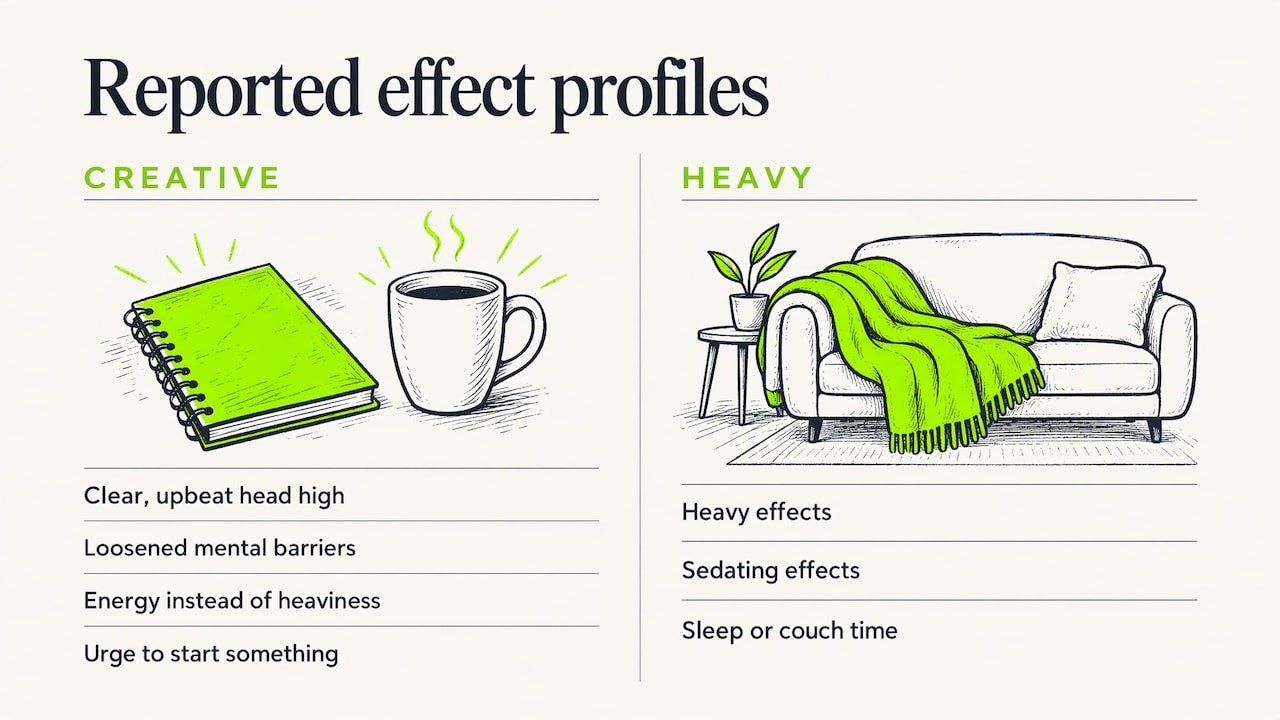
No regulator or lab defines a “creative” strain. It is a user-reported category. When people say a strain is creative, they usually describe a few things: a clear, upbeat head high, a sense of loosened mental barriers, energy instead of heaviness, and the urge to start something. Strains that lean the other way, heavy and sedating, tend to get filed under sleep or couch time.
That is why the same short list keeps appearing. Jack Herer, Super Lemon Haze, Sour Diesel, Blue Dream and Purple Haze are all described as cerebral and energizing. A 2019 Westword feature on strains that boost creativity pairs creative, productive or focused states with Sage N Sour, Lemon Meringue and Super Silver Haze. It also makes the point that finding an inspiring mix of terpenes and cannabinoids is the key, which is a better lens than any single strain name.
Treat any list as a set of starting points. Two jars sold under the same name can differ because of the grower, the phenotype, the harvest and how the flower was dried and cured. This is one reason curated, small-batch sourcing matters: the more attention a grower gives to a cultivar, the closer the jar tends to be to what the name promises.
The strains worth knowing, and what each is known for
Here is a practical shortlist, organized by the kind of creative session you want. Descriptions reflect how these cultivars are commonly characterized by growers and users, not a guarantee of effect.
| Strain | Typical lineage | Commonly described feel | Good for |
|---|---|---|---|
| Jack Herer | Sativa-dominant | Clear, alert, cerebral | Brainstorming, writing, planning |
| Super Lemon Haze | Sativa-dominant | Bright, citrusy, buzzy | Daytime sketching, music, idea generation |
| Durban Poison | Sativa | Energetic, focused, uplifting | Long working sessions |
| Sour Diesel | Sativa-dominant | Fast, energizing, talkative | Social creativity, jamming, conversation |
| Purple Haze | Sativa-dominant | Dreamy, euphoric, imaginative | Visual art, free-form exploration |
| Blue Dream | Sativa-leaning hybrid | Gentle euphoria, relaxed focus | A softer entry point |
| Gelato | Hybrid | Balanced, mellow lift | Creative work that benefits from calm |
Jack Herer and Super Lemon Haze: the classic pair
These two sit at the top of almost every creativity list. Jack Herer is known for a clear-headed lift that suits thinking tasks. Super Lemon Haze is known for a bright citrus aroma and a lively, buoyant effect. If you are new to this category, either is a sensible first jar.
Durban Poison and Sour Diesel: energy first
Both are fast-acting and stimulating. Durban Poison is often described as clean and focused, while Sour Diesel is more talkative and high-energy. They suit active, hands-on work more than quiet, introspective work.
Purple Haze and Blue Dream: imagination and ease
Purple Haze is associated with dreamy, free-association thinking. Blue Dream is the gentle option, a sativa-leaning hybrid known for soft euphoria without a hard edge. If you want to keep working while feeling relaxed, it is a common pick.
Exotic and harder-to-find options
Beyond the familiar names, enthusiasts look for newer, boutique cultivars. Glookies, for example, is mentioned alongside Durban Poison and Super Lemon Haze in discussions of strains favored by working artists. Rare cultivars are the reason small-batch growers exist: low-yield plants are not profitable at scale, so they rarely appear in mass-market inventory. If you like to explore, check the grower’s information on the product page and ask what the aroma suggests about the terpenes.
Why terpenes tell you more than “sativa” or “indica”
Indica and sativa started as botanical labels. Over time they became shorthand for effect, and the shorthand is imperfect. Our guide to indica, sativa and hybrid strains explains how the terms are used and where they fall short.
For creative use, look at three things on the product page or the lab report:
-
Dominant terpenes. Limonene (citrus) and terpinolene (fresh, piney, slightly floral) are commonly associated with bright, energetic strains. If the jar smells like lemon peel or crisp pine, that is a sign.
-
THC percentage. Higher is not better for creative work. More on this below.
-
Minor cannabinoids. CBD, CBN and others shape the experience. Our overview of the entourage effect explains why whole-plant flower feels different from isolated THC.
Your nose is also a tool. Strong, fresh, distinct aromas usually indicate a well-preserved terpene profile. A flat, hay-like smell suggests the terpenes have faded.
Dose decides whether a strain helps or gets in the way
This is the part most strain lists skip. The same strain can feel inspiring at a small amount and scattered at a large one.
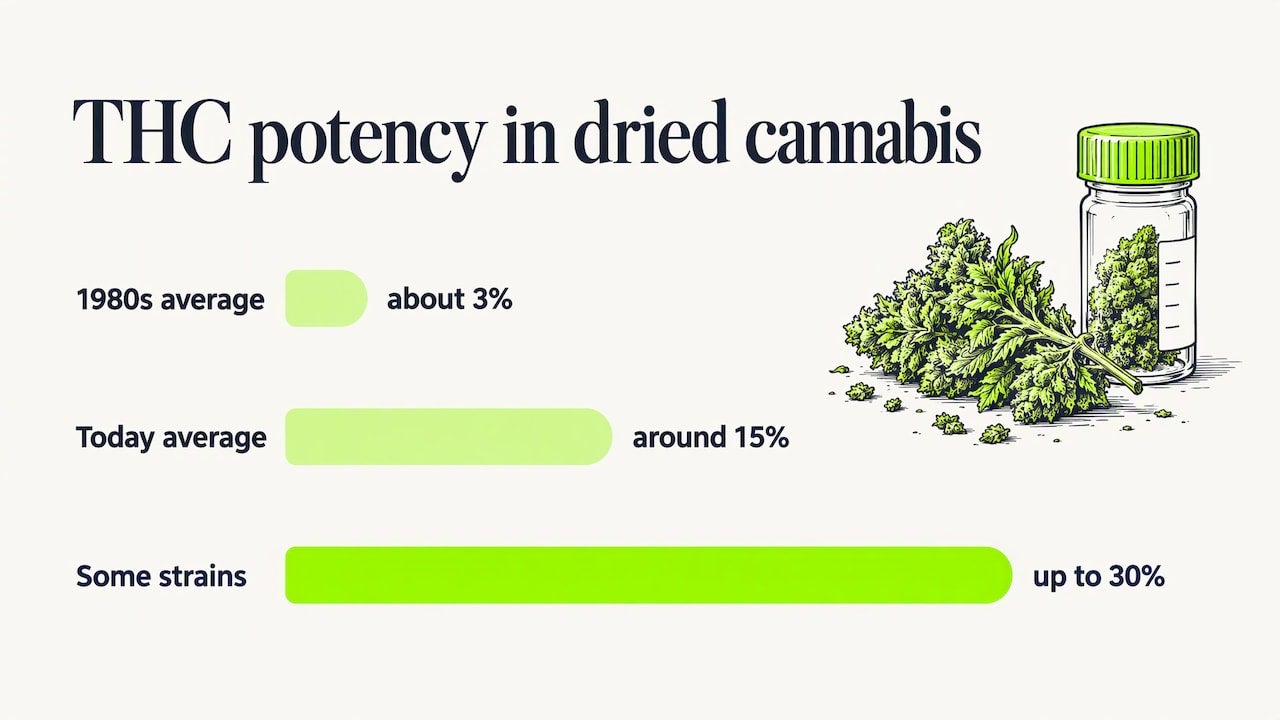
The numbers behind that are clear. Health Canada reports that THC potency in dried cannabis has risen from an average of about 3% in the 1980s to around 15% today, and that some strains can average as high as 30%. The Centre for Addiction and Mental Health (CAMH) notes in its Lower-Risk Cannabis Use Guidelines evidence brief that higher THC potency is strongly linked to greater acute and long-term health risks, including mental health problems and cannabis use disorder.
In a 2014 Dutch experiment, 22 mg of THC impaired divergent thinking in regular users, while a 5.5 mg dose did not. For a creative session, that is a good reason to keep amounts modest.
If you want to understand where “high THC” begins, read what is considered high THC. For a broader look at the two main cannabinoids, see THC vs CBD.
A simple way to dose a creative session
-
Start small. Take a small amount and wait. Inhaled effects appear within minutes, but give yourself time before deciding you want more.
-
Pair with the task. Use it to begin a project, not to finish one. Many people find the early, loose-thinking stage is where a light dose helps most, and editing is better done clear-headed.
-
Keep notes. Write down the strain, grower, amount and how the session went. After three or four tries you will know your own pattern, which beats any list.
-
Consider a lower-THC or balanced option. A product with more CBD relative to THC can feel gentler. Our guide to the CBD to THC ratio shows how to read ratios.
Individual response varies widely. Body weight, tolerance, mood, sleep and what you have eaten all play a part. A strain that energizes your friend might make you anxious, and that is normal, not a failure of the strain or of you.
Flower, vape or edible: choosing a format for creative work
Format changes the shape of the session as much as the strain does.
-
Flower gives you the most control over aroma and terpene profile, and the effect is quick, so you can adjust in small steps. It is the best way to explore cultivar differences.
-
Vapes offer a fast, measured way to take small amounts. CAMH points to options other than smoking, noting that vaping is less harmful to the lungs than smoking and edibles do not harm them. Our cannabis vape guide walks through the choices.
-
Edibles are slower and longer. They suit a long, steady working block more than a quick burst, and they take patience: the effect arrives later, so wait before taking more. Our comparison of edibles vs. smoking covers timing and cost.
-
Concentrates are strong. If you are curious, begin with our explainer on types of cannabis concentrates and use very small amounts.
Safe use in Canada
A creative session is still a session with a psychoactive product, so keep these points in mind. They come from CAMH’s Lower-Risk Cannabis Use Guidelines:
-
Choose products with lower THC and higher CBD:THC ratios.
-
Avoid smoking where you can.
-
Use occasionally rather than daily.
-
Do not drive or operate machinery for at least six hours after use.
-
Avoid cannabis if you have a personal or family history of psychosis or substance use disorders. If that applies to you, speak with your doctor before using it.
How to choose a creative strain, step by step
-
Define the task. Brainstorming, drawing, writing, music and editing each want a different feel. Bright and energetic for starting, gentler for refining.
-
Pick two or three candidates. Choose from the sativa-leaning list above. Do not try five at once, because you will not be able to compare them.
-
Read the product page. Look for the grower, the THC and CBD figures, and any terpene information. Favor jars with lower-to-moderate THC for creative work.
-
Choose a format. Flower for exploring, vape for measured doses, edibles for long sessions.
-
Start with a small amount. Wait, observe, and write down how it felt.
-
Repeat with a second strain before deciding which is yours.
This routine is also where buying from a curated shop saves time. Small-batch growers are chosen for quality, and when the selection is already narrowed to cultivars worth trying, you spend your effort on the session, not on sorting through weak inventory.
We buy and sell cannabis for people who care about what is in the jar, so here is our view on creative strains.
A strain name is a hint, not a promise. The cultivars that people call creative share a profile: bright terpenes, a lively head effect and a THC level that does not overwhelm. That profile is easiest to find in small-batch, low-yield flower, because growers who give each plant attention are the ones who preserve the aroma and character that the name is meant to signal.
That is the idea behind how we curate. We look for small-batch strains from growers we trust, and we make room for the exotic and hard-to-find cultivars that mass-market shelves skip. Our range covers flower, concentrates, hashish, edibles, vapes, CBD, tinctures and topicals, so you can match the format to the way you work.
Our advice is to treat creativity as a craft with its own routine: choose a cultivar for the task, keep the dose modest, and keep notes. Do that and the strain becomes a tool you understand, instead of a gamble.
Where to find creative strains at Budmail
If you want to try the profile described above, start with our sativa-dominant flower, where the bright, energetic cultivars live. If you prefer a calmer base for refining work, our indica-dominant flower is the place to look. You can also see the whole range on the Budmail homepage, from flower and vapes to edibles and CBD.
Orders over $200 ship free, and our loyalty rewards program gives repeat customers something back. Mix-and-match bulk deals let you try several cultivars in one order, which suits the compare-and-keep-notes approach described above.
Frequently asked questions
What weed makes you the most creative?
There is no single answer, because the effect depends on the cultivar, the dose and you. The names most often mentioned are Jack Herer, Super Lemon Haze, Durban Poison, Sour Diesel and Purple Haze. Try one or two in small amounts and keep notes, because your own response is the best guide.
Are sativa strains better for creativity?
Sativa-leaning strains are the usual starting point because they tend to feel bright and mentally active. The label is not a guarantee, though, so check the terpene profile too. Limonene and terpinolene are commonly associated with energetic, uplifting strains.
What are some exotic strains for creative use?
Beyond the classics, enthusiasts look to boutique and small-batch cultivars such as Glookies, along with limited runs of well-known genetics. These are often low-yield plants from craft growers, which is why they are hard to find in mass-market inventory. Browse our flower range for current small-batch options.
How much THC is too much for a creative session?
There is no universal number, but lower is the safer direction. CAMH links higher THC potency with greater health risks and recommends choosing products with lower THC and higher CBD:THC ratios. Start with a small amount, wait, and do not drive for at least six hours afterward.
Sources
-
CAMH: Canada’s Lower-Risk Cannabis Use Guidelines evidence brief (2019)
-
Kowal et al. (2014): Cannabis and creativity, highly potent cannabis impairs divergent thinking


