
If you are new to edibles or have not had one in a while, start with 2.5 mg of THC or less, wait at least two hours, and only then decide whether you want more. That is the advice Canadian health authorities give, and it fits how edibles work: the effect arrives late, builds slowly and lasts far longer than smoking or vaping. Below you will find how to read the milligram figure on a Canadian package, what each dose range tends to feel like, and a simple routine for finding your own number.
TL;DR
- New or infrequent consumers should look for 2.5 mg THC or less per serving. Use caution between 2.5 and 10 mg, and the most caution at 10 mg or more.
- Effects can start 30 minutes to 2 hours after eating, take up to 4 hours to reach full strength and last up to 12 hours.
- Wait at least 2 hours before a second dose. Taking more too soon is the most common way people end up with an unpleasant experience.
- In Canada, a legal edible package holds no more than 10 mg of THC in total, so the label tells you exactly what you are getting.
- Read both lines on the label: THC per unit and total THC for the package.
Table of Contents
- How to read the THC milligrams on a Canadian edible
- THC edible dose ranges and what to expect
- Why the same milligrams hit people differently
- A simple routine for finding your dose
- Why waiting matters more than the number
- Choosing the right product for your target dose
- If you take too much
- Find your dose with Budmail
- FAQ
- Sources
How to read the THC milligrams on a Canadian edible
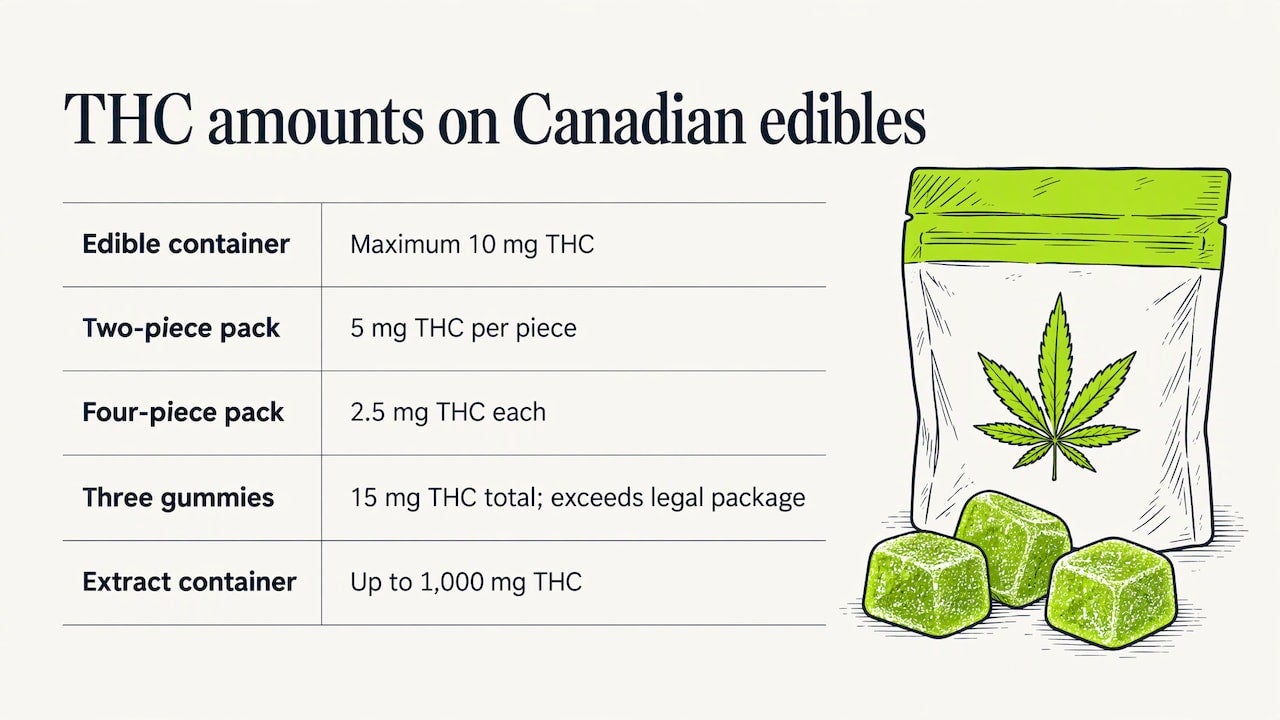
Canada makes dosing easier than most places, because the rules cap and standardize what is on the shelf. Under the Cannabis Regulations, edible cannabis may not contain more than 10 mg of THC per immediate container, meaning the package you actually open. Health Canada describes this limit as a precaution, because edibles look like ordinary food and drink and are easy to overeat.
For products made of separate pieces, such as gummies, chocolates or mints, each piece cannot exceed 10 mg, and a package can hold several pieces as long as each has the same amount and the package total stays at or under 10 mg. So a pack of two pieces can be 5 mg each, and a pack of four can be 2.5 mg each.
The front label shows two figures in milligrams. Health Canada’s label guide explains them: “Total THC per unit” is the amount in one piece, and “Total THC” is the amount in the whole package. Four pieces at 2.5 mg each means 10 mg in the package. The regulations also require the THC figure to account for THCA, the raw form of THC that converts when heated, and the label may not show more than 10 mg of total THC for an edible. The same label lists ingredients, allergens and a nutrition facts table, so you can check what else is in the product.
The practical rule: your dose is the “per unit” number multiplied by the number of pieces you eat. A person who grabs three 5 mg gummies has had 15 mg, which is more than any single legal package contains.
One point of confusion is worth clearing up. Cannabis extracts such as oils, capsules and tinctures follow a different classification and can hold up to 1,000 mg of THC per container, so with those you read the per-dose figure carefully. If you are looking at capsules, our guide to THC capsule dose and timing in Canada walks through it.
THC edible dose ranges and what to expect
Health Canada’s guidance has three bands: 2.5 mg or less for new consumers, caution at 2.5 to 10 mg, and the most caution at 10 mg or more, because higher THC can cause greater impairment and raise the risk of serious adverse effects. The Canadian Centre on Substance Use and Addiction (CCSA) notes that products are sold at 2.5 mg, 5 mg or 10 mg per edible and also advises new users to start at no more than 2.5 mg.
The table below turns those bands into a practical guide. The “what to expect” column is a general description, not a promise: tolerance, body, food and mood all shift the result.
| Dose per sitting | Who it suits | What people commonly report |
|---|---|---|
| 1 to 2.5 mg | First-timers, people returning after a long break, anyone who wants to stay clear-headed | Subtle or barely noticeable; mild relaxation or lifted mood |
| 2.5 to 5 mg | People with some experience, or those who tolerated 2.5 mg well | Clearer relaxation, a noticeable change in mood and perception |
| 5 to 10 mg | Regular consumers with an established tolerance | Strong effects; impairment of coordination and judgment is more likely |
| 10 mg and above | Experienced consumers only | Most caution advised; the maximum in one legal Canadian package |
Two things stand out. First, the full legal package, 10 mg, is a large dose for someone starting out. The Council of Chief Medical Officers of Health makes this point directly: one package can legally contain 10 mg, which is a lot for a first-time or infrequent user. Second, “low” is a legitimate target. Small doses are where many people find the most comfortable, usable effect.
If you want to see the same ladder presented as a chart with serving sizes, our edibles dosage chart for beginners lays it out, and our edible dosage guide explains how the THC figure on a package relates to what you eat.
Why the same milligrams hit people differently
Two friends can eat the same 5 mg piece and have different evenings. The reasons are physical. When you eat THC, it passes through the stomach and liver, where it is converted into 11-hydroxy-THC. Nova Scotia’s government explains that this form is more potent, which is why edibles take longer, can feel more intense and last longer than inhaled cannabis. CCSA adds that both the original THC and the liver-produced form shape the high, and that individual differences in how the stomach and liver process it make timing hard to predict.
In practice, the following all change how a dose feels:
- Tolerance. Someone who consumes cannabis most days needs more than someone who has not had any for months.
- Food in your stomach. Eating on a full or empty stomach changes how quickly you feel it, so compare like with like when you track your doses.
- Body and metabolism. Everyone processes edibles at their own pace, which is why a friend’s number is not your number.
- Setting and mood. Anxiety or fatigue before an edible can colour the experience.
- Other substances. Alcohol and other sedating substances add to impairment. Ask a doctor or pharmacist about interactions if you take prescription medication.
The takeaway is to treat any published dose chart as a starting point and let your own experience set the number.
A simple routine for finding your dose
This is the routine we suggest, built from Canadian public-health guidance.
1. Choose a day with no obligations
British Columbia’s edibles fact sheet recommends clearing at least eight hours of your schedule, being in a safe place with people you trust, and not needing to drive or operate machinery. Do not drive after consuming cannabis.
2. Start at 2.5 mg or less
Pick a product where the label shows 2.5 mg per unit, or split a larger piece. If a gummy is 5 mg and breaks cleanly in half, half is 2.5 mg. This only works when the THC is spread evenly through the product, so check that the piece is uniform, and remember that cutting is easier with gummies and chocolate squares than with a baked item. Products made in discrete units with the same amount in each piece are easier to measure than loose homemade food.
3. Wait the full window
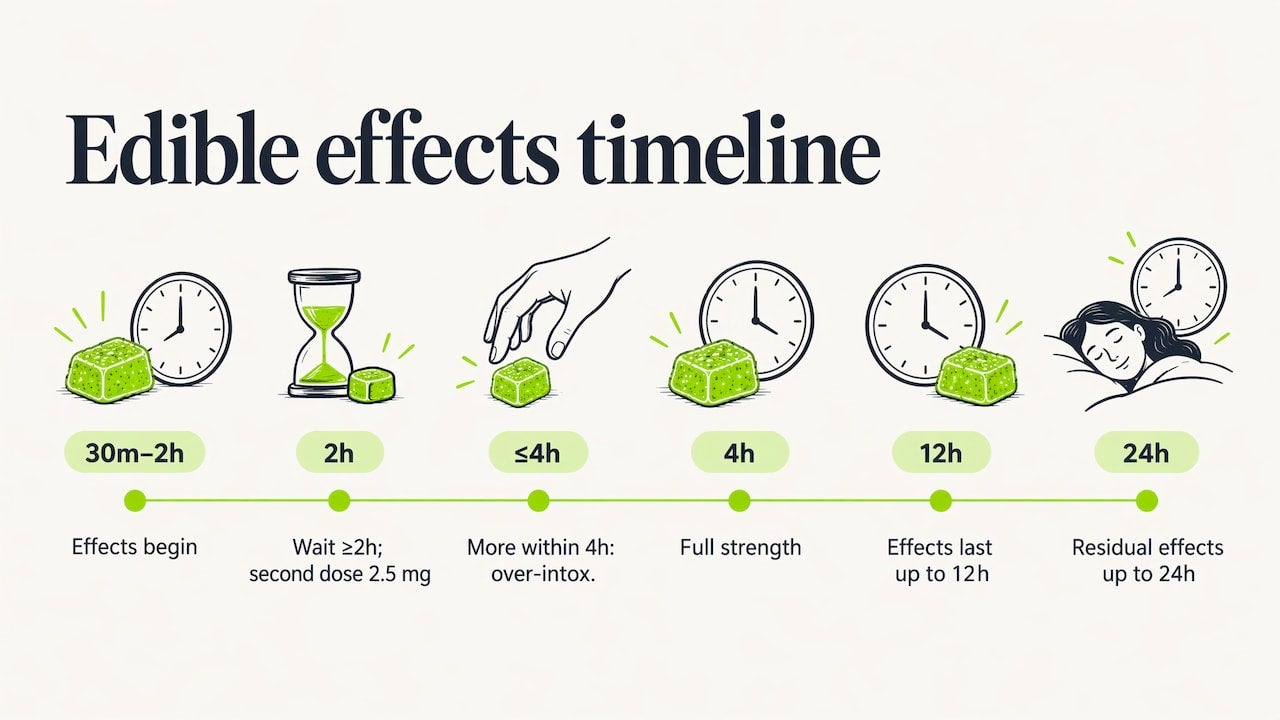
Health Canada says effects can begin 30 minutes to 2 hours after consumption, take up to 4 hours to reach their full strength, last up to 12 hours, and leave residual effects for up to 24 hours. BC advises waiting at least 2 hours before a second 2.5 mg dose and warns that taking more within 4 hours can lead to over-intoxication. Set a timer so you are not tempted to judge the dose at the 40-minute mark.
4. Add in small steps, or stay put
If after two hours you feel little, you can take another 2.5 mg. If you feel good, stay there. There is no prize for the highest dose, and the right dose is the smallest one that gives you what you want.
5. Write it down
Note the product, the milligrams, the time, whether you had eaten, and how you felt at 2 and 4 hours. After two or three sessions you will have your own range, and you can repeat it with confidence.
If you want to know more about how long the experience lasts, see our pages on how long a weed high lasts and how long THC edibles stay in your system.
Why waiting matters more than the number
The single biggest dosing mistake with edibles is re-dosing too soon. The Council of Chief Medical Officers of Health points out that the delay in onset is itself a risk, because people feel nothing, eat more, and then feel both doses at once. Eaten cannabis can produce stronger and less predictable effects than inhaled cannabis.
That is why edibles and smoking need different habits. With inhaled cannabis you can adjust within minutes. With an edible you commit to the amount and then wait. Our comparison of edibles versus smoking covers the differences in onset, duration and experience.
Choosing the right product for your target dose
Once you know your number, the product format decides how easy it is to hit it.
- Gummies and chocolates come in clear pieces, so a 2.5 mg or 5 mg piece is simple to count and, when the amount is the same in each piece, easy to halve.
- Mints and lozenges are small and discreet, and are often made at low per-piece doses.
- Beverages give you a measured serving, though onset and feel can differ from solid food.
- Capsules and tinctures let you measure a dose by the capsule or by the dropper. Read the per-dose figure carefully.
- Balanced products. THC paired with CBD can change how a dose feels. Our guide to the CBD to THC ratio in edibles explains how to read ratios.
For a broader tour of formats, our cannabis edibles guide and the page on the range of THC edibles are good next reads. If you have a high tolerance and want a stronger product, high-potency edibles are grouped on one page, which is for experienced consumers who already know their dose.
If you take too much
It happens, usually because of re-dosing or because a piece was bigger than expected. BC’s fact sheet lists what too much can look like: extreme sedation, anxiety, paranoia, hallucinations, delusions, a rapid heartbeat or slowed breathing. CCSA also lists anxiety and panic, nausea and vomiting, and paranoia among the signs.
What to do:
- Stay calm and stay somewhere safe, ideally with someone you trust. The effects pass, though they can last for hours.
- Do not take more, and do not drive.
- If someone is unwell after consuming too much, call your poison control centre or 911. In BC the fact sheet names BC Poison Control or 911.
- For serious symptoms such as seizure, chest pain, severe headache, shortness of breath, loss of consciousness, or a rapid or irregular heartbeat, contact a health care professional right away.
For comfort measures once the worst has passed, see our page on recovering from cannabis edibles.
Store every edible out of sight and out of reach of children and pets, in its original package. Because edibles look like candy, baking or drinks, accidental eating is the risk the 10 mg limit was designed to reduce.
Our view on edible dosing
At Budmail we think the best dose is the one you can repeat. That is why we pay attention to what goes on the shelf: small-batch, low-yield strains from growers we trust, and edibles whose labels state the milligrams plainly, so you know the number before you eat.
Curating a menu also means curating the dose ladder. Our edibles category covers the low-milligram pieces that suit a careful start, as well as higher-potency options for people with an established tolerance, so you can move up one step at a time rather than jumping from a sample to a full package.
We would rather you take 2.5 mg, wait, and enjoy the evening than take a big piece, wait twenty minutes and regret it.
the author
Find your dose with Budmail
Once you have your target, shopping gets simple: look at the “Total THC per unit” on the label and pick the pieces that match. Our edibles collection lists THC and CBD edibles for Canadian customers, from gummies to beverages, and our CBD range is there if you prefer to keep THC low. Orders over $200 ship free, and our loyalty rewards program adds value on repeat orders, which suits anyone who finds their dose and wants to stock up.
You can also browse everything we carry, including flower, concentrates and vapes, on the Budmail home page.
FAQ
How many mg of THC should a beginner take in an edible?
Health Canada advises new consumers to look for 2.5 mg of THC or less. The Council of Chief Medical Officers of Health gives the same figure and adds that you should wait up to 2 hours to feel effects and up to 4 hours for full effects. If you feel nothing after two hours, you can consider another 2.5 mg.
Is 10 mg of THC a lot in an edible?
For someone new to edibles, yes. Ten mg is the legal maximum for one Canadian edible package, and Health Canada advises the most caution at 10 mg or more. Regular consumers with an established tolerance often use 5 to 10 mg, but the right amount depends on the person.
How do I know how much THC is in a gummy?
Read the front label. “Total THC per unit” is the amount in each piece, and “Total THC” is the amount in the whole package. For example, four pieces at 2.5 mg each add up to 10 mg for the package.
How long should I wait before taking more?
Wait at least 2 hours before a second dose, and remember the full effect can take up to 4 hours to arrive. BC’s fact sheet warns that more within 4 hours can lead to over-intoxication.
How long do edibles last?
Health Canada says effects can last up to 12 hours, with some residual effects for up to 24 hours. Plan your day so you have no driving or work that needs full alertness.
Sources
- How to read and understand a cannabis product label (Health Canada)
- Cannabis Regulations, SOR/2018-144
- Guide on composition requirements for cannabis products (Health Canada)
- Packaging and labelling guide for cannabis products (Health Canada)
- Classification of ingestible cannabis products: Edible cannabis (Health Canada)
- What you need to know if you choose to consume cannabis (Health Canada)
- Edible Cannabis: Always Read the Label (CCSA)
- 7 Things You Need to Know about Edible Cannabis (CCSA)
- CCMOH statement on cannabis extracts, edibles and topical products
- Extracts & Topicals Cannabis (Government of Nova Scotia)
- Health effects of cannabis on adults over 55 (Health Canada)


