
Most people feel an edible 30 minutes to 2 hours after eating it, reach the full effect within about 4 hours, and can stay intoxicated for up to 12 hours, with some residual effects lasting up to 24 hours. That is far longer than smoking or vaping, and it is the reason edible timing is worth understanding before the first bite. At Budmail we sell edibles, tinctures and capsules, and the timeline below is the one we want every customer to know before they order.
TL;DR
- Onset: Health Canada says effects may begin 30 minutes to 2 hours after ingestion and take up to 4 hours to be felt in full.
- Duration: intoxicating effects can last up to 12 hours, and residual effects can linger up to 24 hours.
- Typical window: in controlled research, effects generally peaked 1.5 to 3 hours after eating and lasted 6 to 8 hours.
- Dosing rule: wait at least two to four hours before taking more, depending on which provincial guidance you follow.
- What shifts the clock: dose, body weight, metabolism, sex and whether you ate recently.
Table of Contents
- The edible timeline, hour by hour
- Why edibles last longer than smoking
- What changes how long an edible lasts
- How long to wait before taking more
- A worked example: planning an evening
- Can edibles carry over into the next day?
- If an edible feels too strong
- Safe storage, because the clock matters for children too
- Our view on edible timing
- Choosing edibles at Budmail
- FAQ
- Sources
The edible timeline, hour by hour
An edible does not work like a joint. You swallow it, it is digested, and the THC passes through your gut and liver before it reaches the bloodstream. That is why the wait feels so long and why the effect feels so different.
Here is a practical map of a single, moderate dose. These are ranges, not promises. Your own body decides where you land inside them.
| Stage | Typical timing after eating | What to expect |
|---|---|---|
| Onset | 30 minutes to 2 hours | A first, often subtle shift in mood, body feeling or perception |
| Building | 2 to 4 hours | Effects keep growing; Health Canada says it can take up to 4 hours to feel them in full |
| Peak | Around 1.5 to 3 hours in lab studies, up to 4 hours in official guidance | The strongest point of the experience |
| Plateau and decline | Hours 4 to 8 | Effects ease gradually |
| Tail | Up to 12 hours | Intoxicating effects can still be present |
| Residual | Up to 24 hours | Lingering effects such as tiredness or a slower head |
The 30 minutes to 2 hours onset, the 4 hours for full effect, the 12 hours of intoxication and the 24 hours of residual effects all come from Health Canada’s consumer guidance. British Columbia’s edibles fact sheet gives the same figures.
Why research numbers look shorter
You will see “6 to 8 hours” in many places. That comes from controlled studies. In a study of oral cannabis in brownies, effects generally peaked 1.5 to 3 hours after ingestion and lasted 6 to 8 hours, and the researchers assessed participants for 8 hours. A second study found onset 30 to 60 minutes after ingestion, subjective peaks 1.5 to 3 hours later, and cognitive impairment that peaked anywhere from 2 to 5 hours depending on the task.
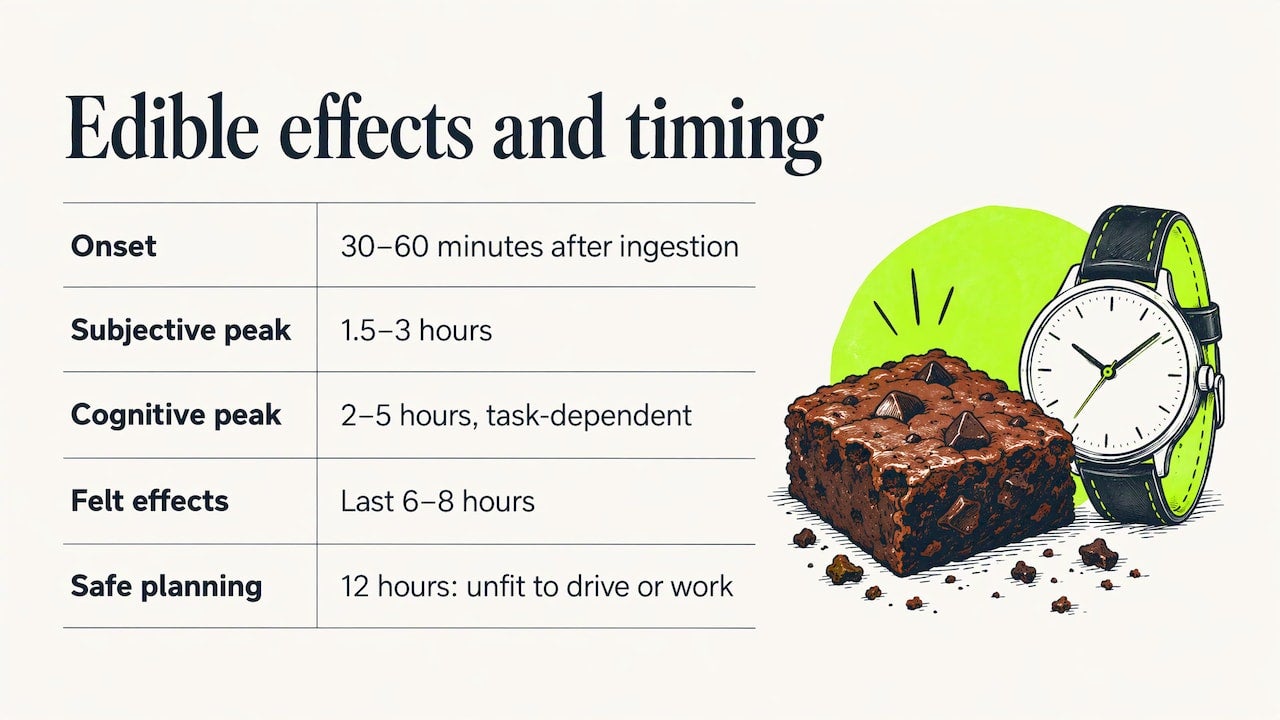
Both views are right. The study window describes how long people felt clearly high under controlled conditions. The 12-hour figure is the safe planning window: how long you should assume you are not fit to drive, work or make big decisions.
Why edibles last longer than smoking
Health Canada explains that swallowed THC takes longer to absorb into the bloodstream, and that the body converts it into a compound called 11-hydroxy-THC. In plain terms, eating cannabis changes both the speed and the character of the experience: it arrives later and it stays longer.
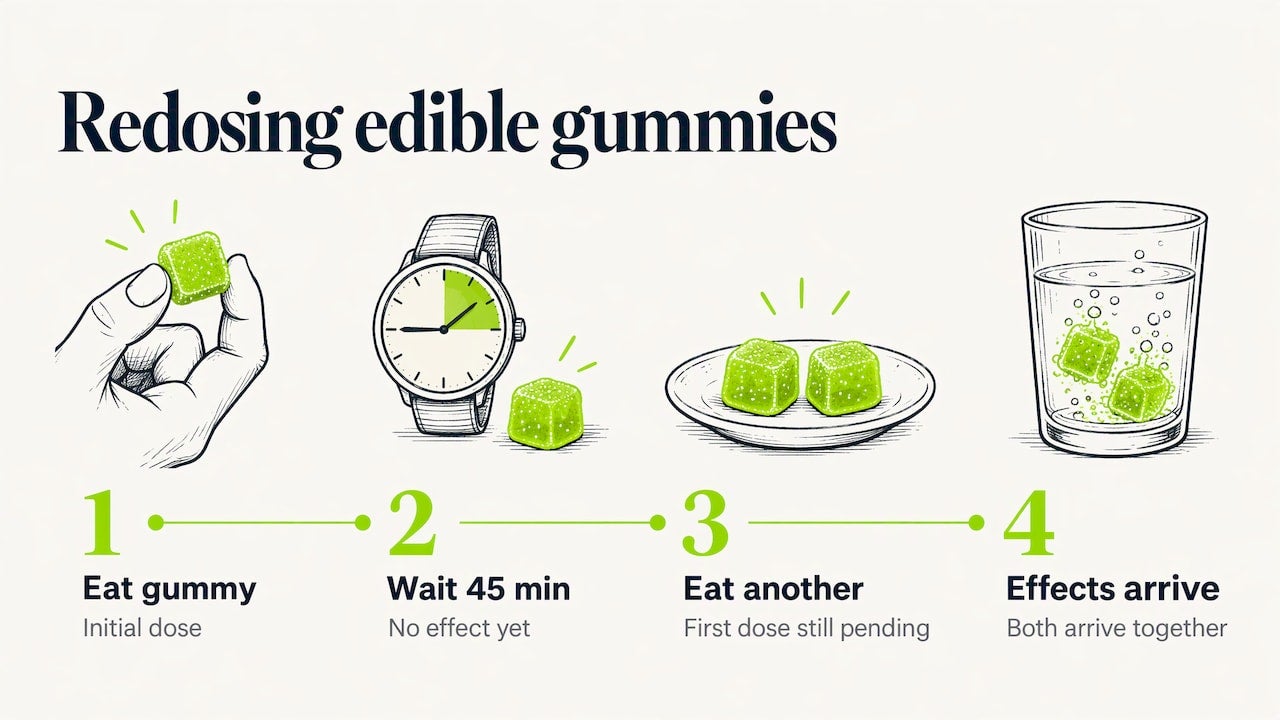
That is also why the classic mistake happens. Someone eats a gummy, feels nothing at 45 minutes, eats another, and then both arrive together. If you want to see how this compares to inhaled cannabis, our guide to edibles versus smoking walks through the differences, and the page on how long a weed high lasts covers the shorter inhaled timeline.
What changes how long an edible lasts
Two people can eat the same product and have very different evenings. These are the factors that matter most.
Dose
A bigger dose means stronger effects and, in practice, a longer stretch of impairment. Health Canada says higher THC levels can cause greater impairment and raise the risk of serious adverse effects. In the 2020 study, brownies with 25 mg and 50 mg of THC produced pronounced effects and marked cognitive and psychomotor impairment compared with placebo, while the test group was made up of healthy adults who rarely used cannabis. A 10 mg dose sat lower on that scale.
If you are new, the dosage chart for beginners and the guide to calculating THC content help you turn a package label into a number of milligrams per serving.
Body and metabolism
British Columbia’s fact sheet names weight, metabolism and sex as individual factors that affect both onset and duration. Nobody can tell you in advance exactly where your body will fall in the range, which is why the first dose should be small.
Food in your stomach
The same fact sheet lists eating on an empty stomach as a factor. Taking an edible with or without a meal changes how quickly it reaches you. We cover the details in edibles on an empty versus a full stomach, and the science of fat and absorption in fat metabolism and edible absorption.
The format you choose
Gummies, chocolates, baked goods, drinks, tinctures and capsules all pass through digestion, so all of them follow the slow edible pattern rather than the quick pattern of inhaling. Within that, the product and the meal around it can shift your timing a little. If you prefer a measured, repeatable format, our guide to THC capsules in Canada explains dose and timing.
How long to wait before taking more
This is the most useful rule in the article, and Canadian health authorities agree on its direction while differing on the exact number.
- Health Canada: its current warning, effective March 12, 2025, says it can take up to 4 hours to feel the effects of ingested cannabis, and that taking more before you feel anything can cause poisoning, including severe anxiety and panic attacks.
- British Columbia: start with 2.5 mg THC or less, and wait at least two hours before a second 2.5 mg dose. The page also cautions that more cannabis within four hours can lead to over-intoxication.
- Manitoba: wait at least four hours before a second serving.
The safest reading is the longest one: start low, wait the full four hours, and only then decide. If you are somewhere you can stay put, that wait is easy. If you are not, do not eat the edible yet.
A worked example: planning an evening
Say you eat a low-dose gummy at 7:00 p.m. with dinner.
- 7:30 to 9:00 p.m.: the earliest and latest points at which you might first notice something. Do nothing.
- By 11:00 p.m.: you are likely at or near the full effect, four hours in. This is the point to judge whether you want more on another day, not tonight.
- Around 3:00 a.m.: at the 8-hour mark, effects have usually eased, though up to 12 hours is possible under Health Canada’s guidance.
- The next morning: residual effects can last up to 24 hours. Plan a slow start and no driving until you feel completely clear.
Notice the shape of that evening: it is built around a full night, not a couple of hours. That is the right way to plan an edible.
Can edibles carry over into the next day?
Yes, for some people. Health Canada says residual effects can last up to 24 hours after use. In practice that tends to mean tiredness, a slower head or a general feeling of being off, rather than the full high. It is more likely after a larger dose or a late-evening one.
What helps is simple: plan the following morning to be easy, drink water, eat, and avoid driving or operating equipment until you feel normal. If you want a practical walkthrough, see how to recover from cannabis edibles.
Duration of effects is also different from how long THC can be detected in a drug test. That question has its own answer in how long THC edibles stay in your system.
If an edible feels too strong
Most uncomfortable experiences are the result of too much too fast, and they pass. Manitoba Health’s advice for overwhelming effects, when there is no chest pain, no seizure and no loss of contact with reality, is to stay somewhere safe and not drive or ride a bicycle. For lesser symptoms it points to poison control or Health Links-Info Sante for advice.
Some situations are not for waiting out. Manitoba urges immediate medical attention for chest pain, panic attacks or seizures. Health Canada’s product alert says to stop using the product and seek treatment from a poison centre, or call 911, if you experience adverse effects. Seek health care for any adverse effect, and report side effects of cannabis products, as the Public Health Agency of Canada notes.
Safe storage, because the clock matters for children too
Edibles look like ordinary snacks, and effects last much longer in a small body. Health Canada’s 2025 warning says edibles can cause life-threatening poisoning in children, especially those younger than five, and tells consumers to keep them out of children’s reach. The Public Health Agency of Canada adds that edibles can be mistaken for regular food and drink, and advises keeping them clearly labelled in child-resistant packaging, stored securely and away from food.
Our view on edible timing
We think the most important thing we can give an edible customer is a realistic clock. The effect arrives late, it builds for hours, and it stays well into the night. People who know that tend to enjoy edibles more, because they choose a dose that fits the evening instead of chasing a feeling.
That is why we curate what we sell, with a focus on small-batch products from growers we trust, and why we publish guides on dosing, absorption and recovery alongside the shop. Quality and a clear label make a predictable dose easier to plan around, and a predictable dose makes the timeline in this article easier to trust.
Our advice is the same for a first-timer and a regular: start low, wait the full four hours, and keep the rest for another day.
the author
Choosing edibles at Budmail
If you are ready to put this timeline to use, our edibles collection includes THC and CBD edibles, and the Budmail home page also lists tinctures and capsules, so you can pick a format that suits how you like to dose. Orders over $200 ship free, and our loyalty rewards program is there for repeat purchases.
If you are exploring the category more broadly, our edibles guide is a good place to start before you order.
FAQ
How long do edibles last?
Health Canada says effects can last up to 12 hours, with residual effects up to 24 hours. Controlled studies often see the clear high last 6 to 8 hours. Plan for the longer window.
How long do edibles take to kick in?
Effects may begin 30 minutes to 2 hours after eating, and it can take up to 4 hours to feel them in full. Eating more because you feel nothing at the one-hour mark is the most common cause of a bad experience.
Is a 10 mg edible too strong for a beginner?
British Columbia advises starting with 2.5 mg THC or less, so 10 mg is a multiple of that starting point. In the 2020 study, healthy adults who rarely used cannabis had stronger effects at 25 and 50 mg. Start low, and let the full four hours pass before any second dose.
Can edible effects be felt the next day?
They can. Health Canada notes residual effects up to 24 hours after use, which people often notice as tiredness or a slower head. Keep the morning easy and do not drive until you feel completely clear.
Why do edibles last longer than smoking?
Swallowed THC is absorbed more slowly, and the body converts it into 11-hydroxy-THC, according to Health Canada. The result is a later start and a longer tail than with inhaled cannabis.
Sources
- Health Canada: What you need to know if you choose to consume cannabis
- Health Canada: Cannabis health warning messages
- Manitoba Health: Good and Bad Experiences (Cannabis)
- Pharmacokinetic Profile of Oral Cannabis in Humans
- Pharmacodynamic dose effects of oral cannabis ingestion
- Health Canada: Cannabis edibles incorrectly sold as cannabis extracts
- Public Health Agency of Canada: CCMOH statement on cannabis extracts, edibles and topicals


