
A hybrid cannabis strain is a cultivar bred by crossing plants with indica and sativa ancestry. Almost every flower on a Canadian shelf today fits that description. The label alone will not tell you how a hybrid feels, so the smart way to choose is to read the THC figure, the terpene content and the lab data, then match them to what you want from the session. At Budmail we curate small-batch, low-yield hybrids from growers we trust, so the strains you read about here are the kind you can browse in our flower category.
TL;DR
- A hybrid is a cross of indica-type and sativa-type genetics. Most modern flower is a hybrid of some kind.
- Research on tens of thousands of lab-tested samples shows indica, sativa and hybrid labels are weak predictors of chemistry and effects.
- Better clues are total THC, total terpenes (especially limonene, myrcene and caryophyllene) and a recent certificate of analysis.
- Start with a small dose. Impairment from THC can last well beyond the high itself, so plan not to drive for at least 6 hours.
- Small-batch, low-yield cultivars are where the rare, standout hybrids usually come from.
Table of Contents
- What a hybrid strain actually is
- The three hybrid styles you will see in a menu
- What the research says about indica, sativa and hybrid labels
- How to choose a hybrid: read the product, not just the name
- Popular hybrid strains and what to expect
- Picking a hybrid for the moment
- Use it safely
- Promo: rare hybrids, delivered
- Our perspective on hybrids
- FAQ
- Sources
What a hybrid strain actually is
Cannabis has traditionally been sorted into three groups. “Indica” was said to be relaxing and body-heavy, “sativa” energizing and head-focused, and “hybrid” a blend of the two. A hybrid is simply what you get when a breeder crosses parents from different sides of that divide, hoping to keep the best traits of each: a flavour, a yield, a type of effect.
In practice breeders have been crossing lines for decades, so the pure types are rare. Cultivars you see named Gelato, Runtz or Cookies descend from many crosses. Shops then describe them as indica-dominant, sativa-dominant or balanced, which is shorthand for how closely a plant resembles one parent type in growth and in reputation.
If you want the full vocabulary, our guide on the difference between indica, sativa and hybrid strains goes through each term. For the sativa side of the spectrum, see how to choose a sativa-dominant strain in Canada.
The three hybrid styles you will see in a menu
Most product pages sort hybrids into three informal styles. They are a useful starting vocabulary, as long as you treat them as a hint and not a promise.
| Style | Typical description | What shoppers usually look for |
|---|---|---|
| Indica-dominant hybrid | Heavier, calmer, dessert-like or earthy aromas | Evening use, winding down |
| Balanced hybrid | Even mix of both parents | A middle path, social settings, relaxed focus |
| Sativa-dominant hybrid | Brighter, citrus or fuel aromas | Daytime use, creative or active plans |
Those expectations are what the market has built around the words. The next section explains why they should not be the final word.
What the research says about indica, sativa and hybrid labels
This is the part most hybrid guides skip, and it changes how you shop.
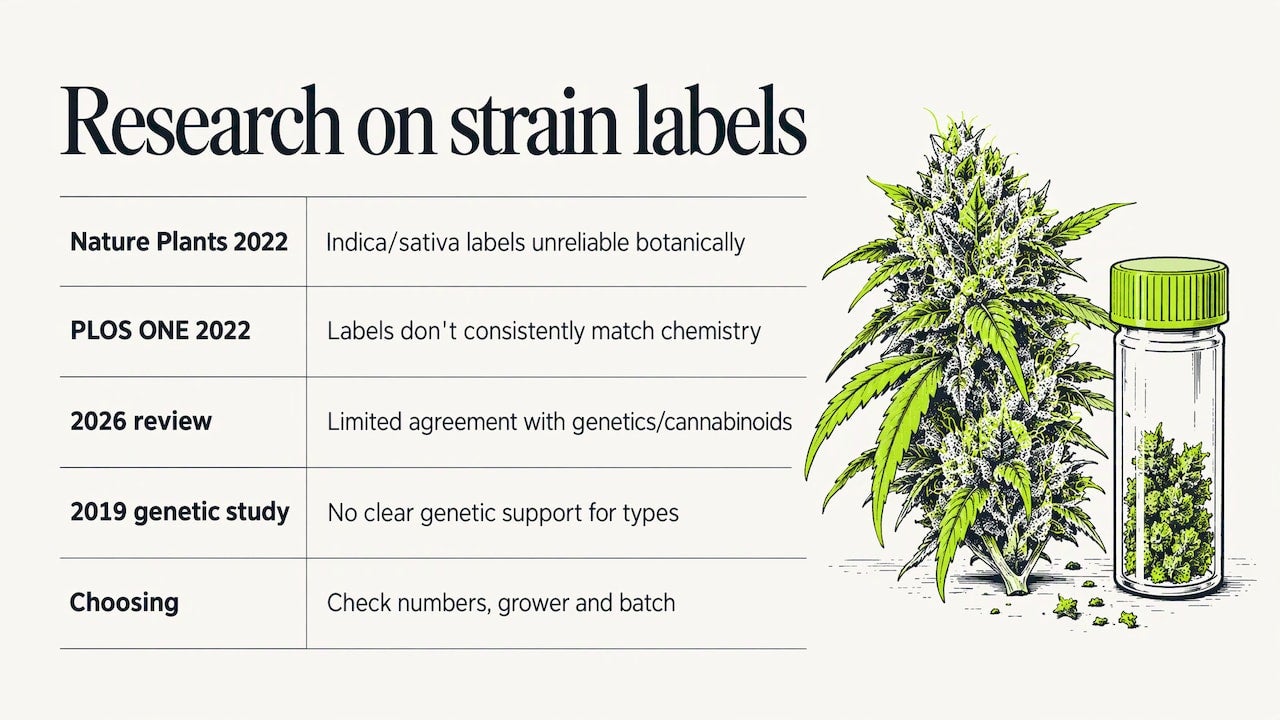
A 2022 study in Nature Plants, reported by Dalhousie University, found that indica and sativa labels are largely unreliable as botanical categories. Strains labelled indica were often just as closely related to sativa-labelled strains as to other indicas, and two products both called OG Kush were more similar to differently named strains than to each other. The same report notes that AK 47 won a Sativa Cup in 1999 and an Indica Cup in 2003. Some weak patterns did exist: indica-labelled strains tended to carry more myrcene, while sativa-labelled ones leaned toward farnesene and bergamotene.
A 2022 PLOS ONE analysis of nearly 90,000 lab-tested samples, summarized by the University of Colorado Boulder, reached a similar conclusion: commercial labels do not consistently line up with the chemical diversity of the products. A flower labelled indica can have a terpene composition indistinguishable from one labelled sativa or hybrid. The authors argued for a nutrition-facts style label that shows terpenes alongside THC and CBD.
A 2026 systematic review of 28 peer-reviewed reports in the Journal of Cannabis Research found the same thing from another angle. Labels showed limited agreement with genetics or with major cannabinoids, and no stable rule linking a label to a terpene profile. The review points to measured chemistry, product form, route of use and dose as more defensible ways to describe a product.
Earlier genetic work agrees. A 2019 study on strain reliability found no clear genetic support for the Sativa, Indica and Hybrid types, and real differences between samples sold under the same strain name. The same authors acknowledge the words still help people describe the range of effects they want, which is why the vocabulary persists.
What this means for you: keep using the words as a rough conversation starter, but choose on the numbers and on the grower and batch behind the flower.
How to choose a hybrid: read the product, not just the name
Here is a practical routine you can run on any product page.
1. Check total THC and CBD
In Canada, THC and CBD content must appear on the label. Health Canada’s guide on how to read a cannabis product label shows where to find them and the standardized cannabis symbol that appears on products with more than 10 micrograms per gram of THC. Flower is usually listed as a percentage or in milligrams per gram, and 10% THC equals 100 mg/g.
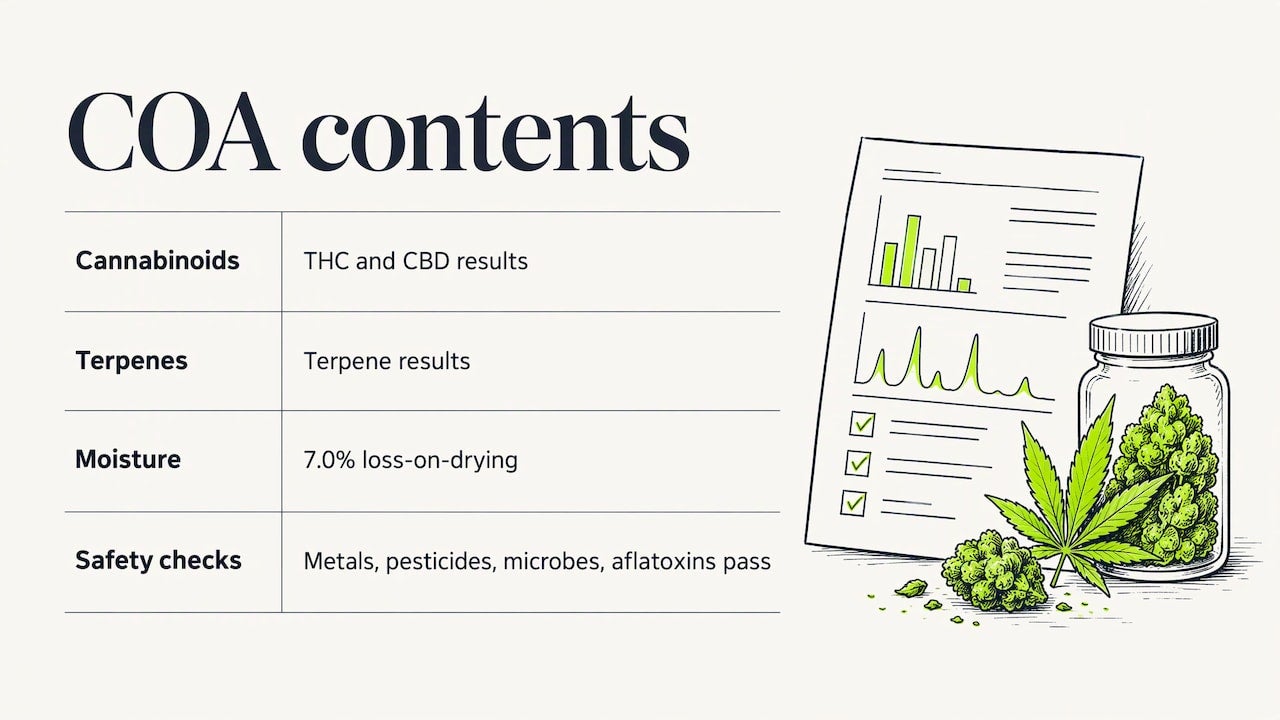
A useful sense of scale: one hybrid flower certificate from a Canadian lab reports total THC of 227 mg/g, which is 22.7%, with 0 mg/g CBD. That is a fairly typical potent hybrid. If you are newer to THC, a lower number is the gentler place to begin. Our explainer on THC versus CBD covers what each compound does.
2. Look at the terpenes
Terpenes are the aromatic compounds in the plant. They shape the smell and flavour, and researchers suspect they may influence how a product feels, an idea known as the entourage effect. Unlike THC, terpene totals are not required on the label, so look for a producer or retailer that shares them.
The same certificate lists total terpenes of 0.9442%. Terpene levels vary by climate, crop age, soil and how the plant is handled, which is one reason two jars of the same strain name can smell different.
Three terpenes show up constantly in hybrids:
- Limonene: citrus, bright and zesty. Read more in our guide to the limonene terpene.
- Myrcene: earthy and musky, common in heavier, calmer flower.
- Caryophyllene: peppery and spicy.
For a broader look, see our overview of cannabis terpenes and the entourage effect.
3. Ask for a certificate of analysis
A certificate of analysis (COA) is the lab report for a specific batch. The hybrid example above lists its THC, CBD and terpene results, a loss-on-drying figure of 7.0% (a measure of moisture), and conforming results for heavy metals, pesticides, microbiology and aflatoxins. Licensed producers in Canada follow Health Canada’s good production practices requirements covering how cannabis is produced, packaged, labelled, stored, sampled and tested.
If you want to understand lab reports in more depth, our guide to lab testing and how to read the results walks through the same logic on CBD products.
4. Use your senses
Good flower has a strong, clear aroma that matches its description, a dense but not bone-dry structure and a clean burn. A grassy, hay-like or musty smell is a poor sign. Because terpenes are volatile, fresher flower smells louder.
5. Favour small batches
Batch size matters because quality tends to slip as volume rises. Small-batch growers can control drying and curing more closely, and low-yield cultivars are often grown precisely for flavour and potency rather than weight. That is the principle behind how we source at Budmail.
Popular hybrid strains and what to expect
The names below recur in Canadian menus. Genetics and potency are what growers and breeders report, and any single jar will differ, so check the batch data on the product page.
- Gelato family: dessert-sweet and usually potent. Gelato crosses such as Jet Fuel Gelato and Lemon Cherry Gelato are among the most-requested hybrids.
- Runtz: a fruity, candy-like hybrid with high THC, a staple of the exotic category.
- Zkittlez: a sweet, candy-leaning cross usually described as indica-dominant.
- Mint Chocolate Chip: a balanced hybrid prized for limonene, myrcene and caryophyllene.
- Strawberry Banana: a fruity cross with limonene, caryophyllene and myrcene.
- Sherbert: a classic indica-leaning cross, generally milder in THC than the newest exotics.
When readers search for the best indica flower strains, they usually want the heavy, evening-friendly end of this list. Indica-dominant hybrids like the Sherbert and Zkittlez crosses above are the usual answer, and the research above is the reason to confirm their myrcene and total terpene numbers on the batch rather than trust the category.
Picking a hybrid for the moment
Use the style as a starting point and the chemistry as the tiebreaker.
- Evening, unwinding: look for an indica-dominant hybrid with an earthy, sweet or musky aroma and noticeable myrcene.
- Daytime, social or creative: look for a balanced or sativa-dominant hybrid with a citrus-forward profile high in limonene.
- First time or returning after a break: choose a lower THC product and a smaller amount than the label suggests you could handle.
- You prefer not to smoke: flower is not the only route. Our guides on edibles versus smoking and edibles versus tinctures explain how onset and duration change by route, and the CBD to THC ratio in edibles shows how to pick a balanced dose.
Use it safely
Hybrid or not, THC affects thinking, coordination and reaction time. Health Canada states that impairment can last more than 24 hours after use, well past the point where you feel high, and that THC can impair your ability to drive. Its lower-risk use guidelines say not to drive or operate machinery for at least 6 hours after using cannabis, and warn that combining it with alcohol increases impairment.
A few habits keep sessions comfortable:
- Start low and wait before taking more. Inhaled effects come on within minutes, while edibles can take much longer.
- Do not combine with alcohol.
- Store flower out of reach of children and pets.
- If you are pregnant or breastfeeding, have a mental health condition or take prescription medication, talk to your doctor or pharmacist before using THC products.
- Cannabis is for adults of legal age in your province or territory.
Promo: rare hybrids, delivered
If you want hybrids chosen for flavour and quality instead of volume, browse the Budmail flower selection. We focus on small-batch, low-yield strains from growers we trust, including exotic cultivars that are hard to find elsewhere. Orders over $200 ship free, mix-and-match bulk deals let you try several strains in one order, and our loyalty rewards program gives repeat customers something back.
If you would rather skip smoking, the same curation applies to edibles, vapes and concentrates.
Our perspective on hybrids
Hybrids are where the interesting work in cannabis happens. Breeders cross a dessert-sweet parent with a fuel-heavy one and the result can be a cultivar nobody has smelled before. That is why we look for hybrids from small batches and low-yield plants: growers who limit volume are usually chasing aroma, resin and a clean cure.
We also think the labels should not carry more weight than they can. The research is clear that indica, sativa and hybrid are loose shorthand. So when we help someone choose, we start with what they want from the session, then look at THC, terpenes and the batch itself. A bright, limonene-rich flower and a heavy, myrcene-rich one can both be hybrids and feel very different.
Our aim is for every customer to find a strain that matches their taste, at a fair price, with free shipping on larger orders and rewards for coming back. Curation is the point: fewer, better strains, chosen with care.
the author
FAQ
What is the best hybrid strain for beginners?
Choose a balanced hybrid with moderate THC and take a small amount. Potent dessert strains can exceed 25% THC, which is a lot for a first session. Wait before taking more, and avoid driving for at least 6 hours.
Is a hybrid better than a sativa or an indica?
Not necessarily. Studies find the three labels predict chemistry and effects poorly, so a hybrid is not automatically smoother or stronger. Compare the THC, the terpene profile and the batch data instead, then pick what suits your plans.
Do hybrids have more THC?
No rule links the hybrid label to potency. Potency depends on the cultivar, the grower and the batch. The label on the package gives the THC and CBD content for the exact product you are buying.
Can hybrid flower be bought online in Canada?
Yes. Online retailers list THC and CBD content, aroma notes and batch details on each product page. Budmail ships across Canada, and orders over $200 qualify for free shipping.
Sources
- Indica and sativa labels are largely meaningless, Dalhousie University
- What’s in your weed? The label doesn’t tell you much, University of Colorado Boulder
- Consumer-facing Indica, Sativa and Hybrid labels, Journal of Cannabis Research
- Genetic tools weed out misconceptions of strain reliability, PubMed Central
- How to read and understand a cannabis product label, Health Canada
- Cannabis certificate of analysis, 4C Labs
- Good production practices guide for cannabis, Health Canada
- Cannabis impairment and safety risk, Health Canada
- Canada’s lower-risk cannabis use guidelines, Health Canada


