
Weed is dried cannabis flower. Hash is the plant’s resin, collected and pressed into a concentrate. That one difference drives everything else: hash packs more cannabinoids into each gram, so it usually hits harder and lasts longer, while flower gives you the aroma, the bud and the lighter, more gradual experience. In Canada both are legal cannabis products, and which one suits you depends on how strong you want the session to be, how you plan to use it and whether you value terpene-rich flower or a dense, resin-based concentrate. At Budmail we carry both, along with hashish and seven other categories, so the comparison below is the one we walk customers through.
TL;DR
-
What they are: weed is the dried flower and leaves of the cannabis plant. Hash is concentrated resin (trichomes), pressed or rubbed into chunks, sheets or paste.
-
Strength: Health Canada puts typical THC for hash and kief at up to 60%, against up to 30% for dried flower.
-
Effects: hash is the stronger option, so start with a much smaller amount than you would with flower. Smoked or vaped, effects peak within 10 to 30 minutes and last 2 to 4 hours.
-
Use: both can be smoked or vaporized, and both can go into edibles. Hash can also be crumbled over flower.
-
Choosing: pick flower for aroma, ritual and a gentler ramp-up. Pick hash for a compact, potent product with a smooth, resin-forward flavour.
Table of Contents
What weed and hash actually are
People use “weed” for the dried buds and leaves you roll, pack in a pipe or grind into a vaporizer. Health Canada describes fresh or dried herbal material as flowers and leaves, and hash or kief as physically concentrated extracts made from loose trichomes or pressed resin.
Trichomes are the tiny, sticky, crystal-like glands on the flower. They hold most of the THC, CBD and aromatic compounds. Hash is what you get when those glands are separated from the plant matter and collected. The Royal Canadian Navy Association’s cannabis awareness guide describes it as the dried, compressed resin of cannabis flower buds, ranging from brown to black and sold in chunks. Modern bubble hash can also be lighter in colour, depending on how it is made.
Two terms worth knowing:
-
Kief: the loose trichome powder that collects at the bottom of a grinder. Press it together and you have a simple form of hash.
-
Cannabis extract: the legal category in Canada. Health Canada treats trichomes removed by sifting, beating or rubbing, such as kief or hashish, as cannabis extracts. Provincial guidance lists hash alongside vaping liquids, tinctures, wax and cannabis oil as extracts.
So on a Canadian label, flower is “dried cannabis” and hash sits in the extracts class. That matters when you shop, because the two are measured and sold differently.
Potency: how much stronger is hash?
The short answer is that hash sits above flower on the potency scale, though the exact numbers depend on who is measuring and which product they mean. Here is what Canadian authorities publish.
| Source | Dried flower (weed) | Hash |
|---|---|---|
| Health Canada | Up to 30% THC | Up to 60% THC (hash and kief) |
| Gouvernement du Québec | 5% to 25% THC | Up to 35% THC |
| Canadian Pharmacists Association | 5% to 30% THC | 20% to 60% THC |
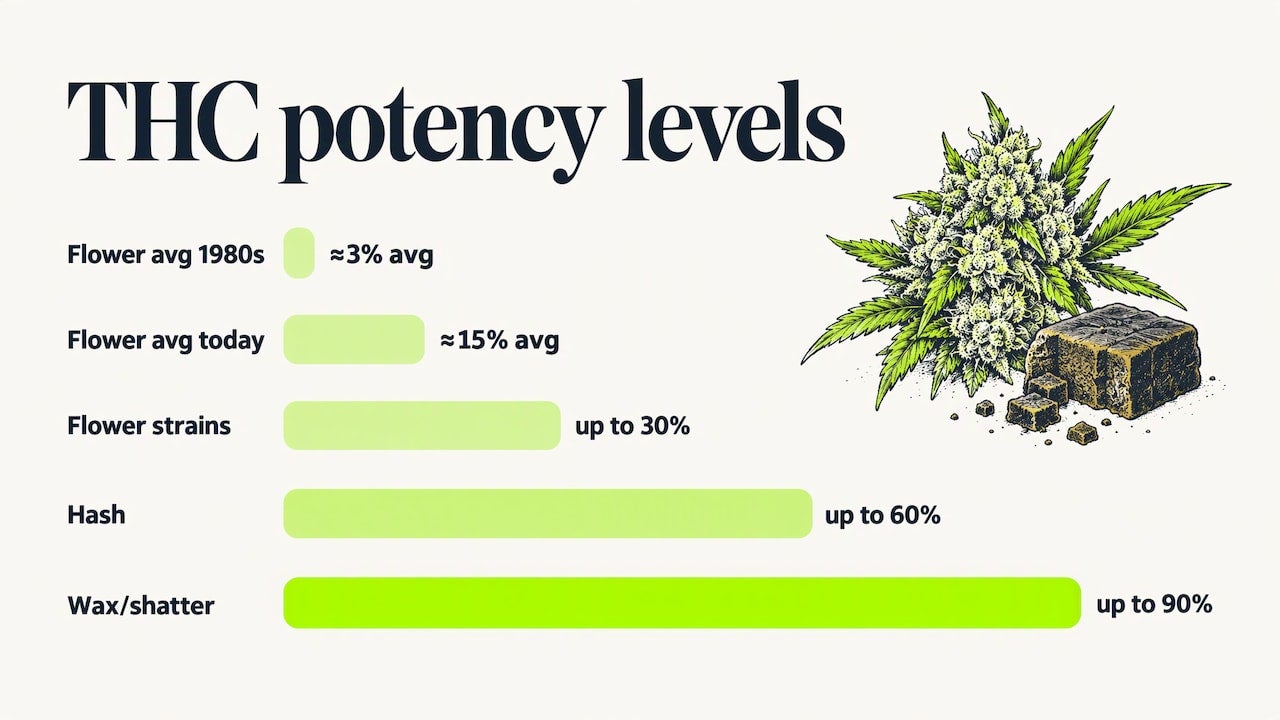
The ranges differ because they describe different samples and different years, but the pattern is the same everywhere: the top of the hash range is higher than the top of the flower range, and hash rarely falls to the low single digits that some flower does. Québec’s page also places hash oil at up to 60% and solid concentrates such as wax and shatter at up to 90%, so hash sits in the middle of the concentrate spectrum rather than at the top.
Flower has also climbed. Health Canada notes that average THC in dried cannabis rose from about 3% in the 1980s to around 15% today, with some strains averaging as high as 30%. Québec attributes the rise to better plant selection, new cultivation methods and crossbreeding. That is why a modern top-shelf flower can rival a mid-range hash on paper. If you want to understand how THC and CBD each shape the experience, our guide to THC vs CBD covers it.
A worked example
Take a gram of flower at 25% THC. That is roughly 250 mg of THC in the whole gram, and only part of it reaches you when you burn it. A gram of hash at 50% holds around 500 mg. The same small pinch of each therefore delivers very different amounts. That is why experienced users often use a fraction of the weight when they switch from flower to hash.
How the effects compare
THC is the compound behind the high. Health Canada explains that THC is responsible for how your brain and body respond to cannabis, including intoxication. CBD, by contrast, is best known for analgesic, anti-inflammatory and anti-anxiety properties without intoxication. Both weed and hash contain both compounds in varying ratios.
What changes between them is intensity and character:
-
Hash: because the resin is concentrated, the effect is typically fuller and more physical, and it tends to feel heavier and longer than the same amount of flower. The taste is often described as earthy, spicy or sweet, depending on the type.
-
Flower: the experience is shaped by the strain’s terpenes, the aromatic compounds that give a bud its citrus, pine or fuel smell. This is where much of the variety lives. If you chase rare, small-batch cultivars, flower is where those differences are most visible.
You cannot assume a strain label alone predicts how you will feel. Your tolerance, your body, the setting and how much you take all matter, and with hash the amount matters more because each puff carries more.
Timing: smoked or vaporized
Health Canada’s guidance says cannabis can be smoked using dried cannabis or extracts such as hash, and that effects may begin within seconds or minutes, peak after 10 to 30 minutes and last 2 to 4 hours. That applies to both products. The practical difference is that a small amount of hash can push you further up that curve, so take one small inhale, wait, and then decide whether you want more.
Timing: eaten or drunk
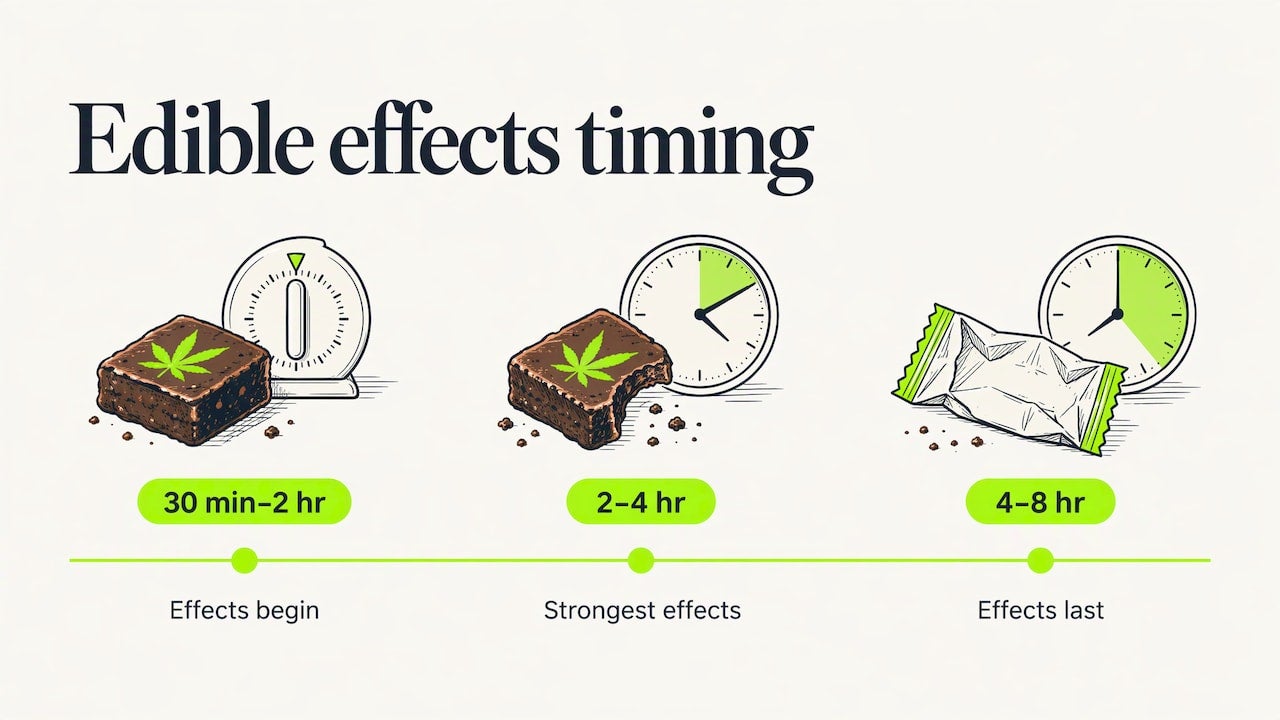
The same guidance says eating or drinking cannabis typically produces effects within 30 minutes to 2 hours, strongest after 2 to 4 hours and lasting 4 to 8 hours. Taking more before the effects arrive raises the risk of poisoning. This is the single most common mistake with edibles: the wait feels long, so people take a second dose. Wait the full two hours.
Ways to use each
Both products are versatile. Québec’s public-health guidance explains that dried cannabis can be rolled and smoked or powdered and vaporized, while extracts such as hashish can be smoked, vaporized or ingested. It adds that solid extracts can be mixed with dried flower or added to food. The Canadian Centre on Substance Use and Addiction likewise says solid extracts such as hash can be vaped, smoked or ingested.
In practice that gives you these routes:
-
Flower in a pipe, joint or dry-herb vaporizer. The classic route, and the easiest way to judge a strain’s aroma and flavour.
-
Hash crumbled on top of flower. A small piece on a bowl or in a joint raises the strength and smooths the flavour.
-
Hash in a pipe or vaporizer made for concentrates. For heat-based use, a compact amount goes a long way. Our guide to what dabbing is and the overview of types of cannabis concentrates explain the tools and terms.
-
Edibles and infusions. Health Canada notes that cannabis oil and tinctures can be used to make other products such as edibles, and that edible potency depends on the amount of extract added. If you prefer to skip inhalation altogether, our edibles range is the simpler path, and our comparison of edibles vs smoking shows how the experience differs.
For readers who prefer edibles for health reasons, the point is that you do not have to choose hash or weed for eating. Whatever the source, the product you buy is labelled with its total THC per package, so you can plan your dose from the label rather than guesswork.
Safety: what actually changes with higher strength
Health Canada states that harmful effects may be greater when the strength of THC is higher. Because hash can reach up to 60% THC and flower up to 30%, the practical rule is simple: use less hash than you would flower, and go slowly.
A few points that apply to either product:
-
The method matters as much as the product. Health Canada identifies smoking as the most harmful way to inhale, because cannabis smoke contains many of the same harmful chemicals as tobacco smoke. It adds that vaping has its own risks but is less harmful to the lungs than smoking. If you want to reduce exposure to smoke, a vaporizer or an edible is the lower-risk route. Our vaping vs smoking article goes into the differences.
-
Do not drive or operate machinery after use. Impairment lasts for hours, and for edibles it can last up to 8 hours.
-
Who should be most careful: anyone who is pregnant or breastfeeding, anyone under 25 whose brain is still developing, and anyone with a history of psychosis or heart conditions should speak to a doctor or pharmacist before using cannabis. If you take prescription medication, ask your pharmacist about interactions first.
-
Storage: keep every cannabis product, edibles in particular, locked away from children and pets.
If you notice that you need more and more to get the same effect, or that you cannot cut back, talk to your doctor or call a provincial health line.
Which one should you choose?
Match the product to what you actually want from the session.
Choose flower if you:
-
want to explore aroma and terpene variety, or hunt rare, small-batch strains
-
like a gradual build you can adjust puff by puff
-
enjoy the ritual of grinding, rolling or packing
Choose hash if you:
-
want a compact, high-potency product that is easy to store and portable
-
prefer a smooth, resin-forward flavour
-
already have a steady tolerance and want a fuller effect from less material
-
want to upgrade your flower by adding a small piece on top
Choose an edible if you:
-
would rather not inhale at all
-
want long-lasting, predictable dosing from a label
-
are comfortable waiting two hours before judging the effect
First-time hash users should begin with a piece the size of a grain of rice, wait at least 30 minutes if inhaling, and only then consider more. If you are looking for a gentler step up from flower, a CBD-balanced product from our CBD range is also an option.
Where to find hash and flower at Budmail
We sell flower, concentrates, hashish, edibles and beverages, vapes, CBD, tinctures and capsules, and topicals, all online, with free shipping on orders over $200 and a loyalty rewards program for repeat orders. If hash is what you are after, start with our concentrates category or look at a specific product such as Rockstar Pressed Bubble Hash, Pressed Bubble Hash in LA Kush Cake or Domestic Pressed Bubble Hash in Kush Mints. For a wider look at the style, read our piece on hash rosin in Canada.
For flower, edibles and everything else in the catalogue, the Budmail home page lists every category in one place.
Our view on hash and weed
We do not think of hash and weed as rivals. We think of them as two ends of the same plant, and the best choice is the one that matches how you want to spend the evening.
What we care about is sourcing. We focus on small-batch, low-yield strains from growers we trust, because that is where flavour and character come from. In flower, that means buds with a clear aroma and a clean finish. In hash, it means resin that was handled with care, so the flavour carries through rather than tasting flat.
We also like giving people room to try. Mix-and-match bulk deals let you sample a flower and a hash side by side, which is the quickest way to learn how each one suits you. Our loyalty rewards program means that finding the one you like pays off over time.
And because strength varies so much between products, we suggest you let the label lead: compare total THC, start with a small amount, and keep hash for when you want something fuller.
the author
FAQ
Is it better to smoke weed or hash?
Neither is better in general. Flower is better if you want aroma, variety and a gradual build. Hash is better if you want a more potent, compact product. If you are new, start with flower or a very small piece of hash.
Does hash get you high?
Yes. Hash is made of concentrated cannabis resin and contains THC, the compound that causes intoxication. Health Canada lists typical THC potency of up to 60% for hash and kief, so the effect can be strong even from a small amount.
What do dispensaries call hash?
In Canada, hash is regulated as a cannabis extract, and stores often list it under concentrates or hashish. You may also see terms such as bubble hash, pressed hash, kief or rosin, which describe how the resin was collected or pressed. Health Canada’s rules include kief and hashish among mechanically extracted cannabis extracts.
Which is more harmful, hash or weed?
The risk depends on strength, amount and method. Higher THC can mean greater harm, and hash usually has higher THC, so use less of it. Smoking is the most harmful way to inhale, whichever product you choose, and vaping is less harmful to the lungs than smoking.
Can I use hash in edibles?
Yes. Solid extracts can be added to food, and edibles take longer to work than inhaled products. Health Canada says effects can take 30 minutes to 2 hours to begin and last 4 to 8 hours, so wait before taking more.
Sources
-
Description and composition of cannabis, Gouvernement du Québec
-
Research (cannabis), Canadian Centre on Substance Use and Addiction
-
Cannabis for medical purposes: using a cannabis product, Health Canada
-
Displaying THC and CBD content on dried cannabis products, Health Canada
-
Health Canada eases regulatory burdens in the cannabis industry, Wildeboer Dellelce


