CBD lab testing is a set of analytical tests run on each batch of a product. It measures how much CBD, THC and other cannabinoids the batch contains, and it screens for contaminants such as pesticides, heavy metals, mold and residual solvents. The results are summarized in a certificate of analysis (COA). In Canada, much of this testing is required by the Cannabis Regulations, so the useful skill is reading a COA and confirming it belongs to the exact product in your hand.
TL;DR
- Lab testing measures potency (THC, CBD and other cannabinoids) and screens for contaminants such as pesticides, heavy metals, mold, bacteria and residual solvents.
- Canadian rules require validated methods on a representative sample of each lot or batch, so a COA is tied to a lot, not to a brand in general.
- Match the lot number, product name, producer and test date on the COA to the package before you trust the numbers.
- Check units, and for flower look at total THC, not just THCA.
- A COA describes a batch. It does not predict how you will feel or make a high-dose product low risk.
Table of Contents
- What CBD lab testing actually measures
- How labs test CBD and other cannabinoids
- What Canadian rules require
- Which contaminants a report may cover
- How to read a CBD certificate of analysis
- Warning signs in a report
- CBD versus THC on the same report
- Our perspective on testing and curation
- Shop CBD with the checklist in hand
- A quick checklist before you buy
- FAQ
- Sources
What CBD lab testing actually measures
A lab report answers two questions: what is in this batch, and is anything in it that should not be? Health Canada’s cannabis laboratory lists chemical analysis covering total THC, CBD and other cannabinoids, heavy metals, residual solvents, mycotoxins, terpenes and screening for unauthorized substances. That list is a good map of what a thorough report can cover.
In practice, results fall into a few groups:
- Potency. The concentration of cannabinoids, mainly THC, THCA, CBD and CBDA. This is the number that ends up on the label.
- Terpenes. The aromatic compounds that shape smell and flavor. They are optional on many reports, but some programs include them.
- Contaminants. Pesticides, heavy metals, mycotoxins, residual solvents and microbes (bacteria, yeast and mold).
- Quality extras. Depending on the product, moisture or water activity may be reported too.
Not every report has every section. The test list should fit the product format. A vape cartridge or oil made with extraction deserves a residual solvent result, while dried flower is more about microbes, moisture and pesticides. If you are comparing formats, our guide to solventless versus solvent-based extraction explains why solvent results matter more for some products than others.
How labs test CBD and other cannabinoids
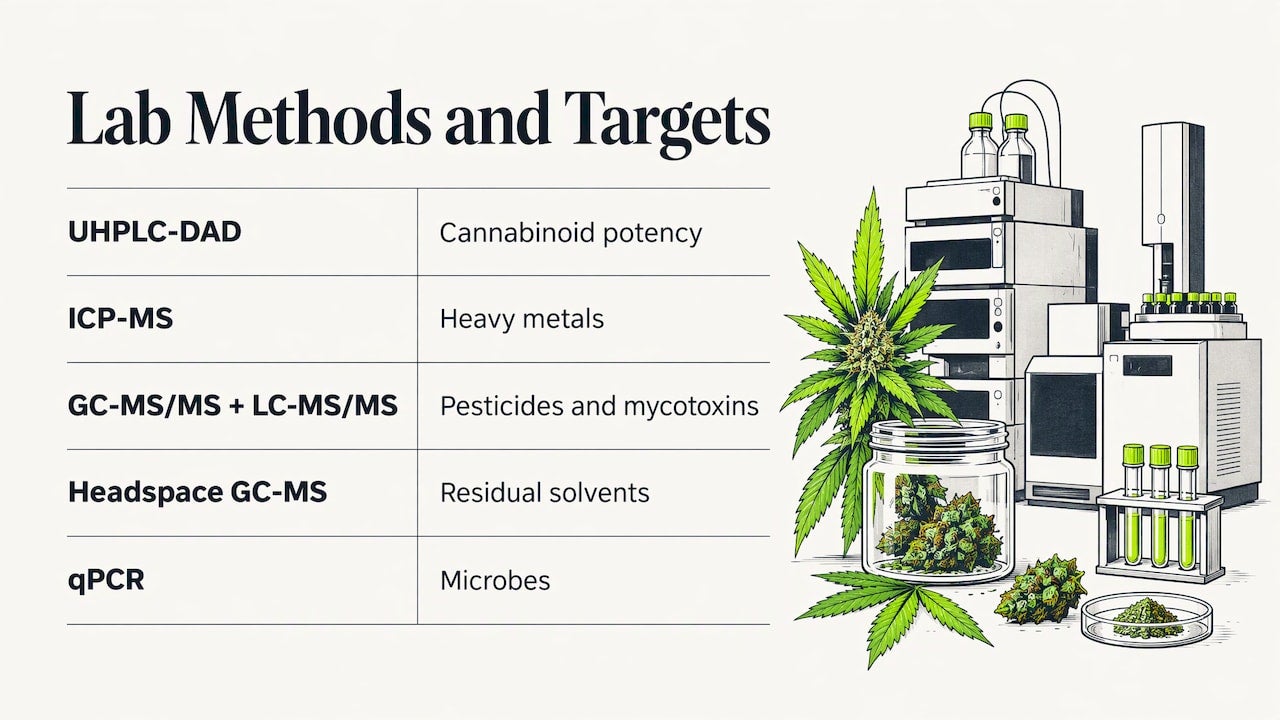
You do not need to run these methods, but knowing the names helps you recognize a serious report. Labs typically use different instruments for different questions. One published methods document describes UHPLC-DAD for cannabinoid potency, ICP-MS for heavy metals, GC-MS/MS and LC-MS/MS for pesticides and mycotoxins, headspace GC-MS for residual solvents and qPCR for microbes.
Why liquid chromatography is so common for potency: a peer-reviewed review notes that HPLC can quantify both the acidic and neutral forms of cannabinoids without derivatization, which matters because raw cannabis holds acidic forms like CBDA and THCA that gas chromatography would convert with heat. The same review points to HPLC-MS/MS as the ideal approach.
Two more details tell you a lab is careful. Cannabinoid concentrations are quantified against a calibration curve made from certified reference materials, with regular calibration checks. And pesticide work monitors several ion transitions to confirm that a detected compound is really what the instrument says it is.
What Canadian rules require
Testing in Canada is not a marketing extra. It is built into the regulations, though the details differ by product class.
Potency and contaminants
Health Canada explains that subsection 90(1) of the Cannabis Regulations requires testing for THC, THCA, CBD and CBDA on each lot or batch, and that the THC and CBD content a lot could yield must appear on the label. Separately, section 91(1) requires microbial and chemical contaminant testing on lots or batches of cannabis other than plants, seeds or edible cannabis that are or will become products.
Methods, samples and retention
The regulations say that testing must use validated methods on a representative sample of each lot or batch, and that a portion of the sample is kept for at least one year after the last sale of any part of that lot. That retention rule is part of why a lot number is meaningful: it lets a specific batch be traced and re-examined.
Who approves a batch
Under Health Canada’s good production practices guidance, every lot must be approved by the Quality Assurance Person before it is made available for sale. That person must confirm that required test results, including pesticide results, are reviewed and fall within the identified specifications.
Independent labs
For pesticides, the testing must be done by a third-party laboratory that holds a licence for analytical testing and operates independently of the person requesting the analysis. Independence is the reason a COA carries weight: the lab has no stake in the result.
Contaminant tolerances
Dried or fresh cannabis may contain microbial or chemical contaminants only if they are within generally accepted tolerance limits for human use set in a publication named in Schedule B to the Food and Drugs Act and appropriate for the intended use. Health Canada’s composition requirements guide states the same principle for dried cannabis: nothing other than a part of the cannabis plant, and no contaminants beyond those tolerances.
Which contaminants a report may cover
The contaminant side of a COA is where the safety information lives. A full panel looks for:
| Contaminant group | What it is | Why it is tested |
|---|---|---|
| Pesticides | Residues from crop protection products | Can remain on plant material and concentrate in extracts |
| Heavy metals | Lead, arsenic, mercury, cadmium | Plants can absorb metals from soil and water |
| Microbes | Bacteria, yeast, mold, including E. coli and Salmonella | Contamination during growing, drying or storage |
| Mycotoxins | Toxins produced by certain molds | Can persist even when visible mold is absent |
| Residual solvents | Leftovers from extraction | Relevant to oils, concentrates and vape products |
The SQDC’s laboratory page confirms that analyses can detect traces of pesticides, bacteria, fungi, residual solvents, mycotoxins and heavy metals, including lead, arsenic, mercury and cadmium. The exact numeric limits depend on the product type and route of use, and limits for inhaled products, edibles and topicals differ from oral limits, so read the limit printed next to each result rather than assuming a single universal threshold.
How to read a CBD certificate of analysis
A COA can look like a wall of numbers. Work through it in this order.
- Confirm it belongs to your product. Compare the product name, producer, lot number, package date and test date with what is on the package. The lot number is usually the strongest match point. Lot numbers refer to a specific harvest, which is what makes a product inquiry and traceability possible.
- Check the lab. The report should name the laboratory that did the testing, and for Canadian products that lab should be one licensed for analytical testing.
- Read potency with the right unit. Results may appear as percent, mg/g or mg per unit. Units can change between sections, and that is one of the easiest ways to misread a report.
- For flower, find total THC. Raw flower contains mostly THCA, which converts to THC with heat. A common way to estimate total THC is THCA multiplied by 0.877, plus THC, and Health Canada uses total THC, not raw THCA, for potency claims and labelling.
- Look at the contaminant panel. Each category should show a result and a limit. A passing pesticide result may be reported as ND (not detected), below the limit of quantification, or a number below the maximum residue limit.
- Match the panel to the format. An oil or vape needs a residual solvent line. An edible’s report should make sense for its form.
Reading “less than” and zero
Health Canada’s guidance permits the less-than sign for quantities below 0.1 mg or below the method’s limit of quantification, and it advises against labelling a product as containing zero THC or CBD unless that can be demonstrated with assurance. So “<0.1 mg” on a COA means the amount is too small to quantify, not that the lab proved there is nothing at all.
Why the COA is the best number on the page
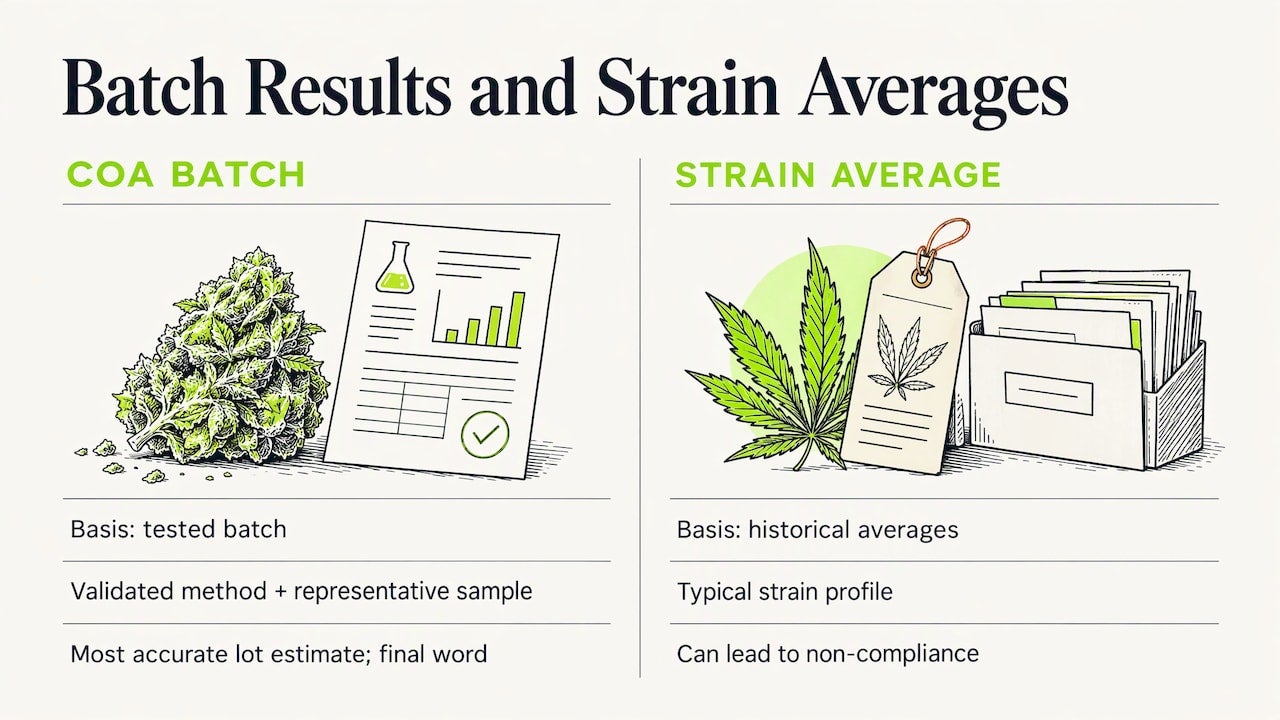
The same guidance states that the COA is the most accurate estimate of a lot’s actual cannabinoid content when a validated method and a representative sample are used, and that label values taken from historical strain averages can lead to non-compliance. In other words, batch-level results beat a strain’s general reputation. That is a useful habit when browsing our CBD strains in Canada: treat a strain’s typical profile as a starting point and the batch result as the final word.
Warning signs in a report
A good report is specific. A weak one is vague. Watch for:
- No batch identifier. Without a lot or batch number, nothing ties the results to the product you hold.
- Mismatched details. A different product name, producer or test date than the package.
- A potency-only report. Potency does not tell you about pesticides, metals, microbes or solvents.
- Changing units. Percent in one section and mg/g in another, with no explanation.
- A test list that does not fit the format. For example, an extracted oil with no solvent result.
- A PDF with no legal source behind it. If the seller is not authorized or the package looks suspicious, a document online is not enough on its own.
One more point of care: a COA describes a batch, not your experience. It does not guarantee a particular effect, prevent overconsumption or make a high-THC product low risk. If you are choosing a dose, especially for edibles, our edible dosage guide shows how to work from the milligram figure on the label.
CBD versus THC on the same report
Many CBD products also contain some THC, and the report is how you see the ratio. If you are unsure how the two compounds differ, read THC vs CBD explained first. For edibles, the ratio matters to how a product feels, and choosing a CBD to THC ratio walks through it. When you read a COA for a CBD edible, check both the CBD and THC lines against the label, not just the one you bought it for. Our overview of CBD edibles covers the format in more detail.
Our perspective on testing and curation
We think a lab report is most useful to someone who knows what to look for, so we would rather you leave this page able to read one than simply trust a badge.
Our approach at Budmail starts earlier, with who grows the product. We focus on small-batch, low-yield strains from growers we consider trustworthy, because careful cultivation on a small scale is where quality begins. That is how we build a catalogue of exotic and hard-to-find products across flower, concentrates, hashish, edibles, vapes, CBD, tinctures and capsules, and topicals.
When you shop with us, apply the habits in this guide to any product you buy: look at the lot, the lab, the units and the contaminant panel. Informed customers are the ones who get the most from a curated selection, and they are the customers we want to serve.
the author
Shop CBD with the checklist in hand
Once you know how to read a batch report, choosing gets easier. We carry CBD products alongside flower, concentrates, edibles, vapes, tinctures and capsules, and topicals, with mix-and-match bulk deals, a loyalty rewards program and free shipping on orders over $200.
If a tincture is what you are after, start with our Boost CBD tincture, or browse everything in our product categories. You can also start from the Budmail home page.
A quick checklist before you buy
Keep this short list handy whenever you compare CBD products:
- Is there a lot or batch number on the package and on the COA, and do they match?
- Does the report name a laboratory and a test date?
- Are potency units clear, and does the CBD and THC content agree with the label?
- Does the contaminant panel suit the product format?
- Are results shown as ND, below the limit of quantification, or within a stated limit?
- Does the dose make sense for your experience level?
If you can answer yes to most of these, the product is documented in the way Canadian regulation intends. If a CBD product is for a pet, read our guide to CBD for dogs and cats and speak with a veterinarian about dosing.
FAQ
Is CBD lab testing required in Canada?
Yes, for regulated cannabis products. The Cannabis Regulations require testing for THC, THCA, CBD and CBDA on each lot or batch, along with microbial and chemical contaminant testing for many product classes. Methods must be validated and applied to a representative sample.
What is a certificate of analysis?
A COA is the lab’s summary of results for one specific lot or batch. It lists potency, contaminant results and the lab, lot number and test date. It is the best evidence of what a particular batch contained when it was tested.
How do I know a COA matches my product?
Compare the product name, producer, lot number, package date and test date on the COA with the package. The lot number is usually the strongest link. If the report has no batch identifier, you cannot be sure it applies to your product.
Does a passing COA mean a product is safe at any dose?
No. A COA confirms what was in the batch and that contaminants were within limits. It does not make a high-THC product low risk or predict your response. Start with a low dose, and talk to a physician or pharmacist if you take medication or have a health condition.
Why does a COA sometimes show “ND” or a less-than sign?
ND means not detected, and a less-than sign means the amount was below what the method can reliably quantify. Neither proves the compound is completely absent, which is why Health Canada advises against labelling products as zero unless that can be demonstrated.
Sources
- Cannabis Laboratory, Health Canada
- Cannabis Regulations (SOR/2018-144), Justice Laws
- Displaying THC and CBD content on dried cannabis products, Health Canada
- Good production practices guide, Health Canada
- Guide on composition requirements for cannabis products, Health Canada
- Manage your cannabis licence, add sales activities, Health Canada
- Certificate of Methodology 2022, InfiniteCAL
- Methods for quantification of cannabinoids: a narrative review, PMC
- How to Read a Cannabis COA, GrowerIQ


