
THC edible capsules are swallowed softgels or capsules that hold a measured amount of THC, usually in an oil. In Canada, each capsule is capped at 10 mg of THC. Effects arrive slowly, often after 30 minutes to 2 hours, and can last for hours. The right capsule is the one with a dose that fits your experience, a clear label and a format you will use consistently. This guide covers how they work, how they compare with other edibles, and how to pick one.
TL;DR
- Capsules deliver a fixed THC amount per unit, with no chewing, no taste and no sugar, which makes dosing simple to track.
- Health Canada says ingested cannabis can take 30 minutes to 2 hours to start working and up to 4 hours to reach full effect, so wait before taking more.
- Canadian rules cap THC capsules at 10 mg per capsule and 1,000 mg per package. New consumers are advised to look for 2.5 mg or less per unit.
- Read the label for total THC and CBD, ingredients, storage and the standardized cannabis symbol.
- Gummies, chocolates, tinctures and capsules each suit a different routine. The right pick depends on how you like to dose.
Table of Contents
- What THC capsules are and why people choose them
- How long THC capsules take to work
- How much THC is in a capsule, and what dose to start with
- Capsules vs other edibles: which format fits you
- What to check on a THC capsule label in Canada
- Side effects and how to reduce them
- How to choose the right capsule
- Shop capsules and more at Budmail
- FAQ
- Sources
What THC capsules are and why people choose them
A THC capsule is a small oral dose form, much like a vitamin or a supplement. Inside is a cannabis extract, commonly suspended in an oil, with a labelled amount of THC, CBD or both. You swallow it with water. There is nothing to chew and no flavour to mask.
That simplicity is the main appeal. A capsule gives you a predetermined amount per unit and removes the need to measure liquid for each dose. This can make a routine, or a personal journal of what you took and how it felt, easier to keep, as one Canadian medical cannabis provider explains. The same source is clear that a capsule does not guarantee identical effects every day. Meals, digestion, other medications and individual sensitivity all change how much THC your body absorbs.
People tend to reach for capsules for a few practical reasons:
- Discretion. A capsule looks like any other supplement and has no smell.
- Consistency. Every unit carries the same labelled amount, so you can take half or one or two without guessing.
- No sugar or sweeteners. Useful if you prefer to keep your diet simple.
- Easy to travel with inside Canada, within the product’s packaging and the rules of where you are.
Capsules are also a natural step for people who already enjoy edibles and want a more exact, tasteless version of the same experience.
How long THC capsules take to work
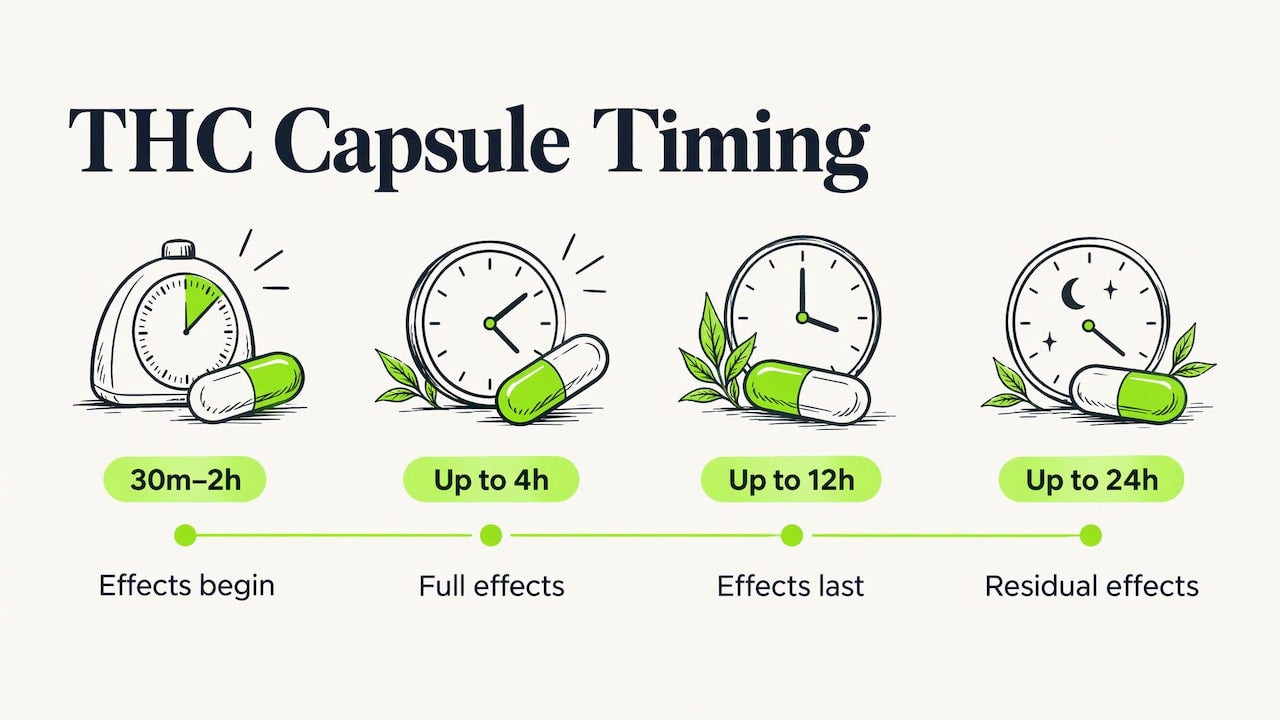
Patience is the whole game with any ingested cannabis. Health Canada states that when you eat or drink cannabis, including oils in capsules, effects start within 30 minutes to 2 hours, may be strongest after 2 to 4 hours, and may last 4 to 8 hours. Timing depends on the product format, other oral medications and what is in your stomach.
For general consumers, Health Canada’s wider guidance gives a longer window: it can take 30 minutes to 2 hours to begin to feel effects, up to 4 hours for the full effects, with effects lasting up to 12 hours and some residual effects up to 24 hours. Plan your day around the longer end of that range, especially the first time you try a new product or dose.
Why oral THC feels different from smoking
When you swallow THC, it passes through your digestive system and liver before it reaches the rest of your body. Some of it is converted to active compounds, including 11-hydroxy-THC. A pharmacokinetic review of oral cannabinoids found that oral THC has high variability between people, with peak blood levels at about 2 hours after a dose, and that only 4 to 12% of an oral dose reaches systemic circulation, compared with 8 to 24% for smoked THC.
In practice, this means two things. First, the experience can feel different from inhaling, and often more prolonged. Second, you cannot simply convert a smoked amount into a capsule amount. Start from the capsule’s own label.
Food, body and timing
What you ate matters. A study of encapsulated THC extract found that a high-fat meal significantly delayed the time to peak THC levels and changed the total exposure. The same study found that, after 5 mg of THC in a fasted state, females had a significantly higher peak concentration than males. The Government of BC adds that onset and duration vary with weight, metabolism, sex and whether you take cannabis on an empty stomach.
The takeaway: take your capsule in the same way each time, such as with a similar meal, so you learn how it works for you.
How much THC is in a capsule, and what dose to start with
Canadian law sets the ceiling. For cannabis extracts in units meant to be swallowed, such as capsules, Health Canada limits THC to 10 mg per unit and 1,000 mg per package. That is why a 100-count bottle tops out at 10 mg capsules, and why you will see 5 mg and 2.5 mg options in larger counts.
Health Canada’s guidance on ingested cannabis uses three bands:
| THC per unit | Health Canada guidance |
|---|---|
| 2.5 mg or less | Look for this if you are a new consumer or want to minimize risk |
| 2.5 mg to 10 mg | Exercise caution |
| 10 mg or more | Exercise the most caution, as higher levels can cause greater impairment and raise the risk of serious adverse effects |
These bands come from Health Canada’s consumer guidance. For adults over 55, Health Canada advises capsules or softgels with 2.5 mg THC or less per unit, and waiting up to 4 hours to feel the full effects.
A cautious first-time routine
- Choose a low-dose capsule. Aim for 2.5 mg THC or less. If your capsules are 5 mg or 10 mg, ask yourself whether that is the right starting point for you.
- Take one dose, then wait. The Windsor-Essex County Health Unit recommends starting at 2.5 mg THC or less and waiting at least 4 hours before taking more.
- Do not stack doses. CAMH notes that ingested cannabis can take up to two hours to show effects and that it is safer to wait about four hours before deciding on another dose.
- Keep notes. Write down the dose, the time, what you had eaten and how you felt.
- Adjust slowly. Change one thing at a time, and only after the previous dose has fully worn off.
If you use cannabis for a medical reason, Health Canada recommends a starting dose of 2.5 mg THC once per day, and 1.25 mg if you are over 55, have certain health conditions or take medications that may interact. If you take other medications or have a heart, liver or mental health condition, talk to your doctor or pharmacist before starting THC.
Our edible dosage guide and dosage chart for beginners walk through how to read milligrams on any edible label.
Capsules vs other edibles: which format fits you
Capsules are one of several ways to take THC by mouth. The active ingredient is the same. What changes is the taste, the dosing precision, the speed and your routine.
| Format | Strengths | Best for |
|---|---|---|
| Capsules and softgels | Fixed dose per unit, no taste, no sugar, discreet | A steady routine, precise dosing, a journal |
| Gummies, chocolates, baked goods | Flavour, easy to split, social | Casual use, people who enjoy the taste |
| Beverages | Familiar format, sipping pace | People who like a drink-style product |
| Tinctures and oils | Flexible dose, can be placed under the tongue | People who want to fine-tune amounts |
The real difference between a capsule and a gummy is less about the THC and more about the experience around it. A gummy is something you taste and share. A capsule is something you take. If you want a flavour-free option with a clean label, a capsule suits you. If you want to enjoy the ritual, you may prefer a gummy or chocolate.
For a closer look at the flexible-dose side of things, see our comparison of edibles versus tinctures. For a broader overview of the format, our guide to cannabis edibles covers the basics, and our range of THC edibles shows what else is out there.
Capsules or smoking?
Inhaled cannabis acts within minutes and fades sooner. Ingested cannabis takes longer and lasts longer. If you are weighing the two, our piece on edibles versus smoking compares effects and cost.
What to check on a THC capsule label in Canada
A legal Canadian product carries a lot of information. Use it. Here is what Health Canada requires, according to its label guide:
- The standardized cannabis symbol on the front of products with more than 10 micrograms per gram of THC
- Total THC and CBD amounts
- Net weight or volume and the number of units
- Recommended storage conditions
- A keep out of reach of children warning
- Manufacturer contact information
- Ingredients in descending order of weight for extracts and edibles
Three checks matter most for capsules.
1. THC per capsule, not per bottle. A bottle might say 500 mg or 1,000 mg total. Divide by the number of capsules to get your actual dose. A 500 mg bottle of 50 capsules is 10 mg per capsule.
2. The THC to CBD balance. Health Canada explains that cannabis products can contain mostly THC, mostly CBD or a combination, and may include other cannabinoids and terpenes, and that label amounts and formulation help guide choice and affect absorption. Many people who want a gentler experience look at balanced products. Our guides to THC versus CBD and the CBD to THC ratio in edibles explain how the ratio shapes the feel.
3. The ingredient list. Check the carrier oil and the capsule shell for any allergy or sensitivity. The label lists ingredients in descending order of weight.
Health Canada also says that there is not yet enough scientific information to recommend a specific product for any particular health condition. You and your health care provider find what works through careful, gradual adjustment. Higher amounts of THC are linked with a higher risk of certain side effects.
Side effects and how to reduce them
THC capsules can cause the same effects as other forms of THC. Common ones include anxiety, dizziness, dry mouth, nausea, a faster heart rate, red eyes and impaired coordination and thinking. Leafwell’s overview of cannabis capsules lists these and recommends beginners choose the lowest THC dose and wait two hours before judging the effect.
Most unpleasant experiences with edibles come from the same cause: taking more before the first dose has fully arrived. The Government of BC notes that the slow onset of edibles increases the risk of overconsumption. A few habits help:
- Start with the lowest-dose capsule you can find.
- Take it on a day with nothing to do and no driving. Effects can last up to 12 hours, with some residual effects up to 24.
- Keep water and a snack nearby.
- Store capsules in their original package, away from children and pets.
- If you feel too strong an effect, rest somewhere calm and call your local poison centre or a health professional if you feel unwell. Our article on how to recover from edibles has practical steps.
Never drive or operate machinery after taking cannabis, and do not mix it with alcohol. Keep all cannabis away from children.
Our perspective on capsules
We see capsules as the most precise way into edibles. When a customer tells us they want to know exactly what they are taking, the label on a capsule answers that question better than almost any other format: one unit, one number.
That is also why we care about where our products come from. Budmail is built around finely curated cannabis, with a focus on small-batch, low-yield strains from growers we trust. We bring the same thinking to every category we carry, including tinctures and capsules, edibles and beverages, CBD and more: a clear label, a reputable source and fair pricing.
Our advice is simple. Start low, write down what you take and let the dose arrive before you decide on the next. Capsules make that routine easy, and our team of curators is happy to build a mix of formats around it, from a steady capsule for daily routine to a flavourful edible for the weekend.
the author
How to choose the right capsule
Use this short checklist when you compare products:
- Decide your dose first. Pick the per-capsule THC amount that matches your experience, then choose a product that offers it.
- Decide on THC, CBD or both. A THC-only capsule is direct. A balanced one pairs THC with CBD.
- Check the pack size. Larger counts of lower-dose capsules give you more room to adjust gradually. The legal cap of 1,000 mg per package means a 5 mg capsule can come in packs of up to 200, and a 2.5 mg capsule in even larger ones.
- Read the full label. Look for the cannabis symbol, total THC and CBD, ingredients and manufacturer contact information.
- Match the format to your life. If you like to dose in tiny steps, a tincture may suit better. If you want a fixed number every time, choose a capsule.
If you are exploring CBD alongside THC, a good starting point is our full spectrum CBD capsules, a CBD option in the capsule format.
Shop capsules and more at Budmail
Budmail is an online cannabis marketplace in Canada. Our tinctures and capsules category sits alongside flower, concentrates, hashish, edibles and beverages, vapes, CBD and topicals, all curated with quality and value in mind. We also offer mix-and-match bulk deals, free shipping on orders over $200 and a loyalty rewards program for repeat customers.
Browse the full selection on the Budmail homepage and pick the format and dose that fit you.
FAQ
Do THC capsules work?
Yes, they deliver THC through digestion, and the effects are the same kind you would expect from other edibles. They take longer to begin than inhaled cannabis, often 30 minutes to 2 hours, and the experience can feel stronger or longer because of how the liver processes THC. Individual results vary with food, body and other medications.
What is the difference between weed capsules and edibles?
Both are swallowed and processed the same way. Capsules give you a fixed dose in a flavour-free, sugar-free unit, while gummies, chocolates and drinks add taste and a social element. Choose capsules for precision and routine, and other edibles for enjoyment.
How many mg of THC should I start with?
Health Canada advises new consumers to look for 2.5 mg of THC or less per unit when ingesting cannabis. Wait at least 4 hours before taking more. If you are over 55, take certain medications or have a health condition, speak to your doctor or pharmacist first.
What is the most THC a capsule can contain in Canada?
Health Canada caps THC at 10 mg per capsule and 1,000 mg per package for cannabis extracts meant to be swallowed. That is why you will see packs of 100 capsules at 10 mg, or 200 at 5 mg.
How do I pick the best THC capsules?
The best capsule is the one with a dose you can handle, a clear label and a source you trust. Check total THC and CBD, count the capsules, read the ingredients and consider a lower dose in a bigger pack so you can adjust slowly.
Sources
- Health Canada: Using a cannabis product for medical purposes
- Health Canada: Choosing a cannabis product for medical purposes
- Health Canada: What you need to know if you choose to consume cannabis
- Health Canada: Health effects of cannabis on adults over 55
- Health Canada: How to read and understand a cannabis product label
- Health Canada: Final regulations on new cannabis products
- Windsor-Essex County Health Unit: Cannabis edibles
- CAMH: Do you know cannabis
- PMC: A review of oral cannabinoids and medical marijuana
- PMC: Human pharmacokinetic parameters of orally administered THC
- Coverleaf: Medical cannabis capsules and edibles
- Leafwell: Cannabis capsules, benefits, risks and dosing


